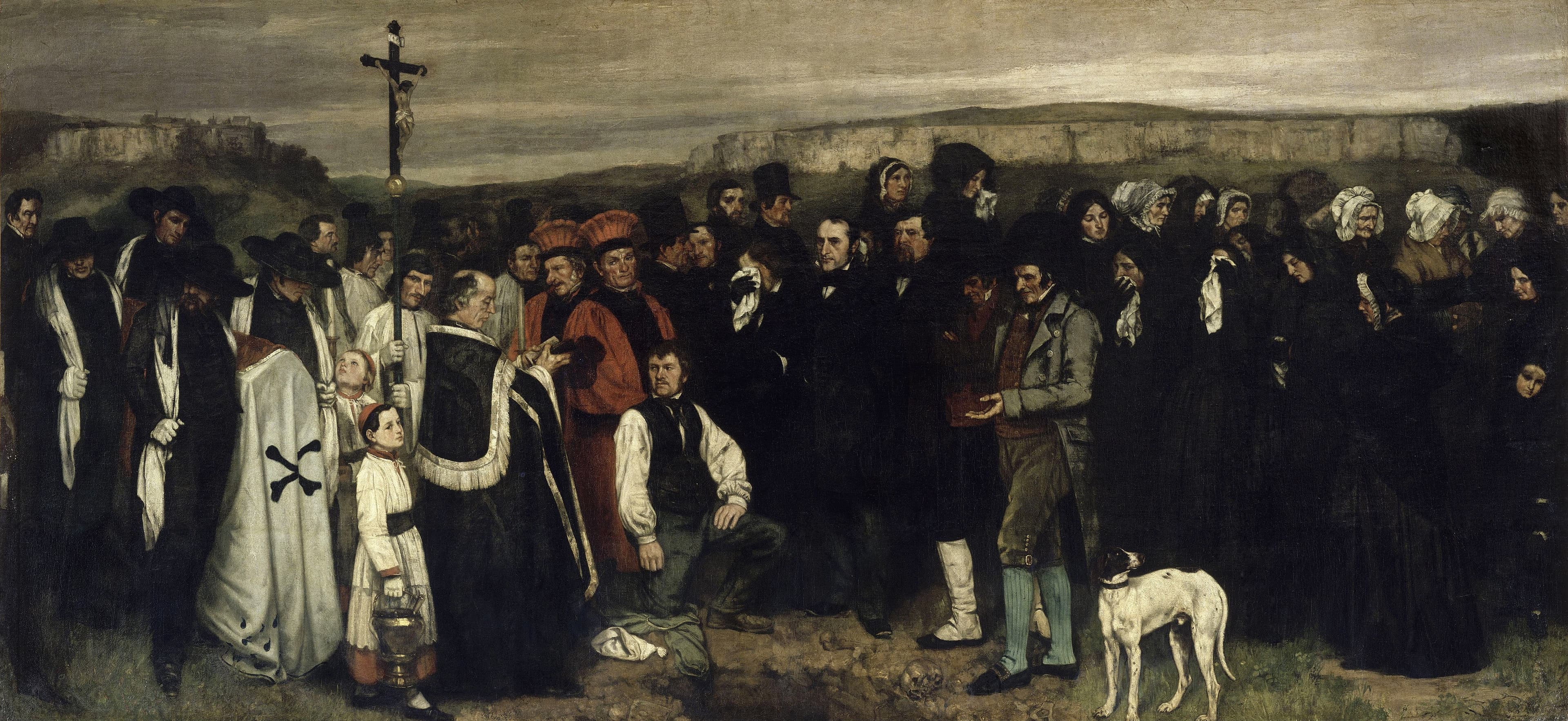
A Burial at Ornans
A village funeral, painted on the scale of a grand history painting
The sheer size of the canvas stops you in your tracks.
Approximately 6.68 meters wide and 3.15 meters tall.
This monumental work is Courbet's masterpiece, A Burial at Ornans.
The scene it depicts is anything but extraordinary.
A funeral for Courbet's maternal grandfather, held in his hometown of Ornans.
Just an ordinary burial in a provincial village.
And yet, that very ordinariness was a radical provocation at the time.
Neither nobles nor heroes — just ordinary people
In that era, canvases of this scale were typically reserved for "great subjects" — royalty, aristocracy, and the heroes of war.
A large-format canvas demanded enormous expense and time.
Yet Courbet placed ordinary country people in that hallowed space.
Not wealthy patrons,
not heroes destined for the history books.
In fact, most of the forty-six figures in the painting were Courbet's actual family members and neighbors.
He placed them front and center, as though they were the protagonists of a history painting.
Not everyone is grieving
Not everyone is grieving
Look closely at the painting, and something feels slightly off.
For a funeral, the expressions on people's faces are remarkably varied.
Some bow their heads,
some stand with vacant stares,
and some don't look particularly sad at all.
There is even a man whose nose has gone a vivid shade of red.
He looks as though he had a drink or two the night before.
But then, funerals are exactly like this.
The family is shattered with grief,
while those who have come from afar are comparatively composed.
Courbet did not conceal that reality.
He neither beautified it
nor exaggerated the emotion.
What Courbet truly wanted to paint
This unflinching realism drew fierce criticism from the critics of the day.
"Vulgar."
"Why paint a funeral on such a colossal scale?"
But Courbet understood perfectly well
why people were made uncomfortable.
Because he was not simply painting a funeral —
he was making a declaration: "Ordinary people, too, can be the subjects of art."
Courbet was a painter of socialist convictions.
And so, instead of kings and heroes,
he wanted to paint the real people of the age in which he lived.
A painting that thrust reality directly in the viewer's face
Courbet submitted this work to the Salon of 1850.
His technical mastery was undeniable, and the painting was awarded a prize.
Yet the controversy refused to die down.
It was too real,
too unsparing in its honesty.
People were accustomed to beautiful fictions,
but the reality spread across an enormous canvas was something altogether unfamiliar.
Perhaps, with this painting, Courbet was proclaiming to the world
that art no longer belonged exclusively to the aristocracy.