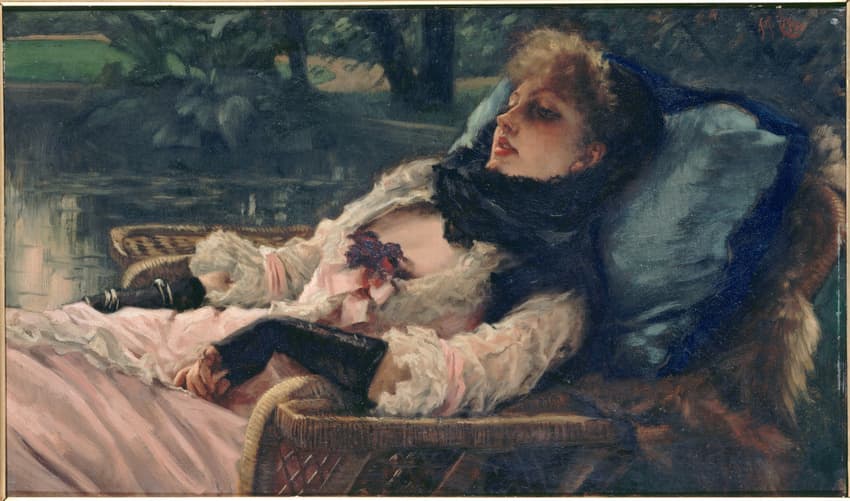
A Woman Dreaming
She is gazing somewhere far away
The woman is leaning back on a sofa.
Her body looks at ease, yet her expression is curiously distant.
Her gaze is calm, and still.
But the longer you look, the more you sense a loneliness settled within it — one that resists easy description.
As though part of her has already begun, quietly, to drift somewhere else.
The subject of this painting is Kathleen Newton — the woman the painter James Tissot loved.
And this is no ordinary portrait.
It is something closer to a record of a man trying to hold on to the time in which the person he loved was slowly disappearing.
She was a controversial figure in London society
Kathleen Newton was a rather well-known woman in London at the time.
Not for flattering reasons, however.
In her late teens, she married a British official stationed in India.
The marriage did not last, and she eventually divorced.
She later fell in love with a naval officer and had a child with him.
This may sound unremarkable by today's standards, but Victorian England was a profoundly conservative society.
The label of "a divorced woman with an illegitimate child" followed her without mercy.
But Tissot paid little heed to such social judgments.
He fell in love with Kathleen Newton, and after returning to London, began living with her in a common-law marriage.
Love undid his life — and completed it at the same time
At the time, Tissot was an exceptionally popular painter.
He had built considerable success as a society portraitist, celebrated for his elegant and refined depictions of the English upper classes.
But when word spread that he was living with Kathleen, his aristocratic clients began turning away one by one.
His reputation and income quickly began to falter.
Financially, things grew increasingly difficult.
And yet, strangely, Tissot would later describe this period as the happiest of his life.
Because now, instead of painting aristocrats for money, he was free to paint, again and again, the person he truly loved.
In hindsight, painting had ceased to be his profession — it had become his way of loving.
He was painting the hours of her disappearance
But that happiness was not to last.
Kathleen contracted tuberculosis.
At the time, tuberculosis was a disease for which there was virtually no cure.
The illness wore her down slowly, and Tissot had to watch as she grew ever weaker.
There was little he could do.
And so he painted.
He tried to hold onto the canvas the time they had shared, the expressions that remained, the moments that were slipping away.
The painting before you now was born in exactly that way.
That is why Kathleen's face does not read as simply elegant.
There is something tired in it, something quiet, something suffused with a faint and wordless sorrow.
Tissot must have already known.
That this time would not last.
The time they loved lasted only six years
Tissot and Kathleen had only six years together.
Long, if you choose to see it that way — and far too short, if you don't.
But some loves are measured less by duration than by the depth with which two people truly saw each other.
That is why, the longer you linger with this painting, the less it feels like a portrait.
Instead, it feels as though the grief of a painter losing the one he loved is slowly seeping through the surface of the canvas.
Perhaps what Tissot wanted was not to preserve her face — but to hold on to the vanishing hours of a love that was already leaving him.