Annunciation
The moment a single lily changed one person's fate
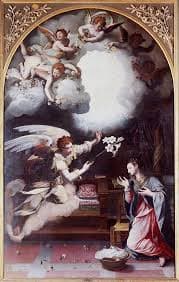
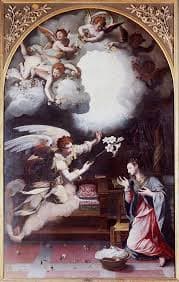
The angel approaches in perfect silence.
In his hand, a white lily.
And Mary is about to hear the words
that will change her life entirely.
The subject of this painting — the Annunciation — depicts the moment the archangel Gabriel announces to the Virgin Mary that she will bear the Christ child.
It is, quite literally, the delivery of the news: "You are with child."
Every flower carries a meaning
Look closely, and small flowers appear throughout the composition.
The yellow blossoms held by the putti above are jasmine.
Jasmine blooms in May — and in the devotional calendar of the time, May was the month consecrated to the Virgin Mary.
Then there is the lily Gabriel holds.
This flower signifies the Virgin's purity.
It is, in essence, a symbol underscoring the fact that she conceived by the Holy Spirit.
Notice, too, the red carnation fallen to the floor.
Exquisitely beautiful as it is,
it foreshadows the blood and sacrifice Christ will one day shed.
This painting, then, is not simply about the moment of birth —
it already holds within it a prophecy of Christ's death.
An age that demanded piety in paint
This work offers a vivid illustration of the exacting standards the Catholic Church placed on art of the period.
In the wake of the Reformation, the Church was acutely conscious of Protestant criticism.
Paintings could not afford to be overly ornate or emotionally extravagant.
Instead, they had to be immediately legible to all,
reverent in tone, and unambiguous in message.
The pictorial space reflects this: the composition is rigorously ordered,
and the expression of emotion carefully restrained.
Drawing the divine into the everyday
What is striking, however, is that the painter has woven unmistakably ordinary objects into the scene.
The basket below,
the chair behind Mary — these are the furnishings of a real home, recognizable to any contemporary viewer.
Because of this, viewers could experience the scene not merely as a Biblical episode,
but as "a moment that could happen right here, right beside us."
Perhaps that was precisely what the Church of the time was seeking.
Not a faith dwelling in some remote, celestial realm,
but a faith that steps into the very midst of people's lives.