Arearea (Joyfulness)
Joy Found Where Civilization Stops
For Gauguin, Tahiti was never merely a destination.
He believed he had discovered there an emotion that civilization had lost.
That emotion was joy.
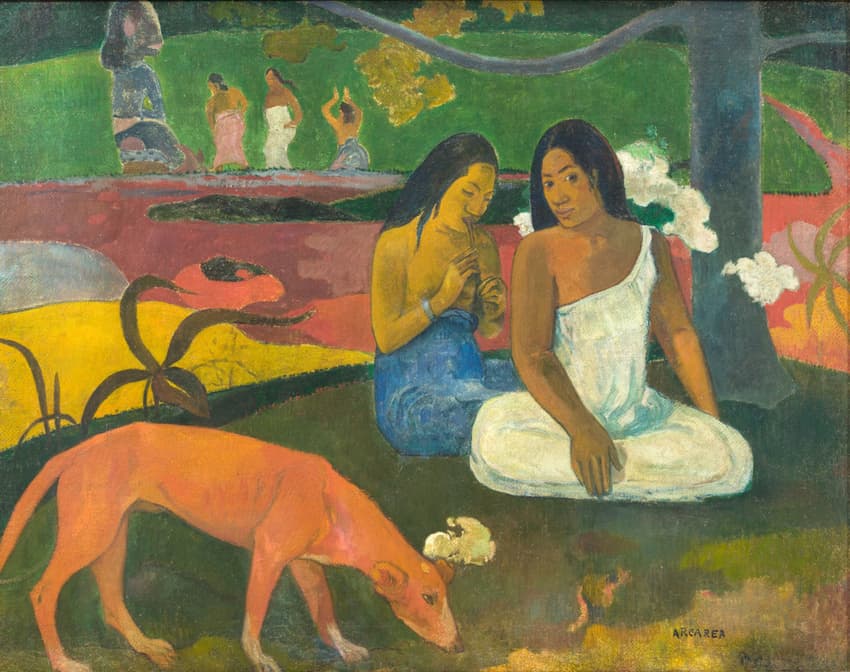
"Arearea" means "joy" in Tahitian.
So what kind of joy did Gauguin find on this island?
A Painting Through Which Music Flows
Two women sit side by side.
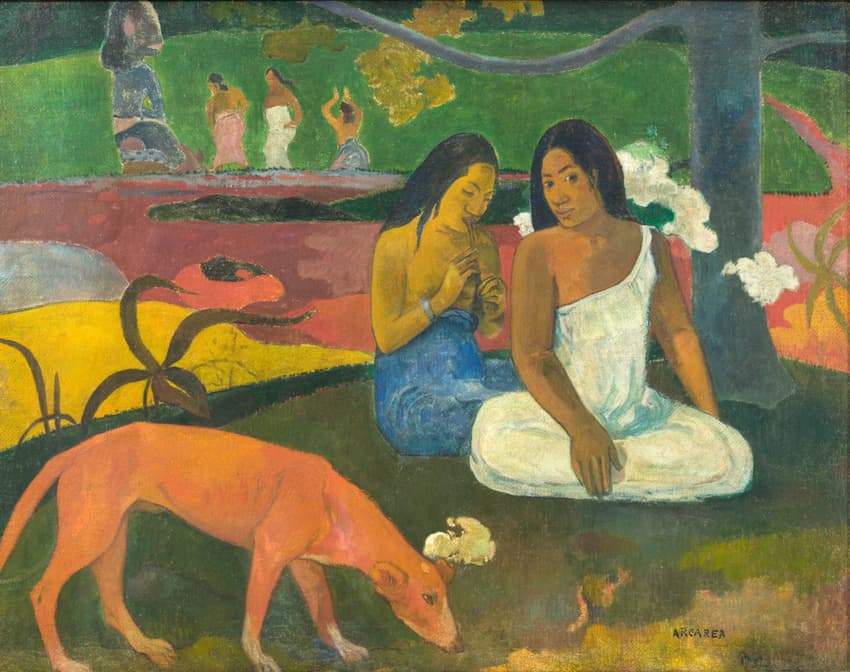
Gauguin was not simply trying to document a landscape.
He wanted to paint the mysterious atmosphere he himself felt — to make it visible.
Colors More Intense Than Reality
What strikes the eye most forcefully in this painting is, above all, the color.
Red earth, lush green nature, deep blue and vivid orange garments.
Rather than blending naturally as they might in reality, the colors are placed so that they seem to collide with one another.
Look closely and you will notice that the color is applied in broad, flat expanses.
As a result, the canvas feels more decorative than three-dimensional — less like a real landscape than a scene from memory or a dream.
Gauguin's paintings are less a representation of nature than a translation of emotion into color.
The Utopia Gauguin Dreamed Of
Gauguin was not painting only the actual landscapes of Tahiti.
He wove together the nature he observed, the lives of the islanders, and the myths and religion they held — blending them into a single world. He layered imagination over reality.
His paintings therefore seem to stand, in a strangely compelling way, at the border between reality and dream.
Human and nature, dance and music, faith and everyday life — all coexist quietly, without conflict.
Perhaps the "joy" Gauguin spoke of was precisely such a moment.
The most primal and peaceful sense of being alive — one forgotten amid civilization and its relentless competition.
A Painter Who Wanted to Paint a New World
Gauguin went on to paint, again and again, works charged with a primitive and mythic atmosphere entirely unlike that of industrialized Europe. At the time, many found them strange and difficult to understand.
Yet his effort to break free from the conventions of existing art and conjure an entirely new world was, without question, something singular.
Gauguin did not paint Tahiti as it was.
Perhaps he was painting the utopia he had spent his life searching for.