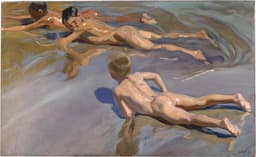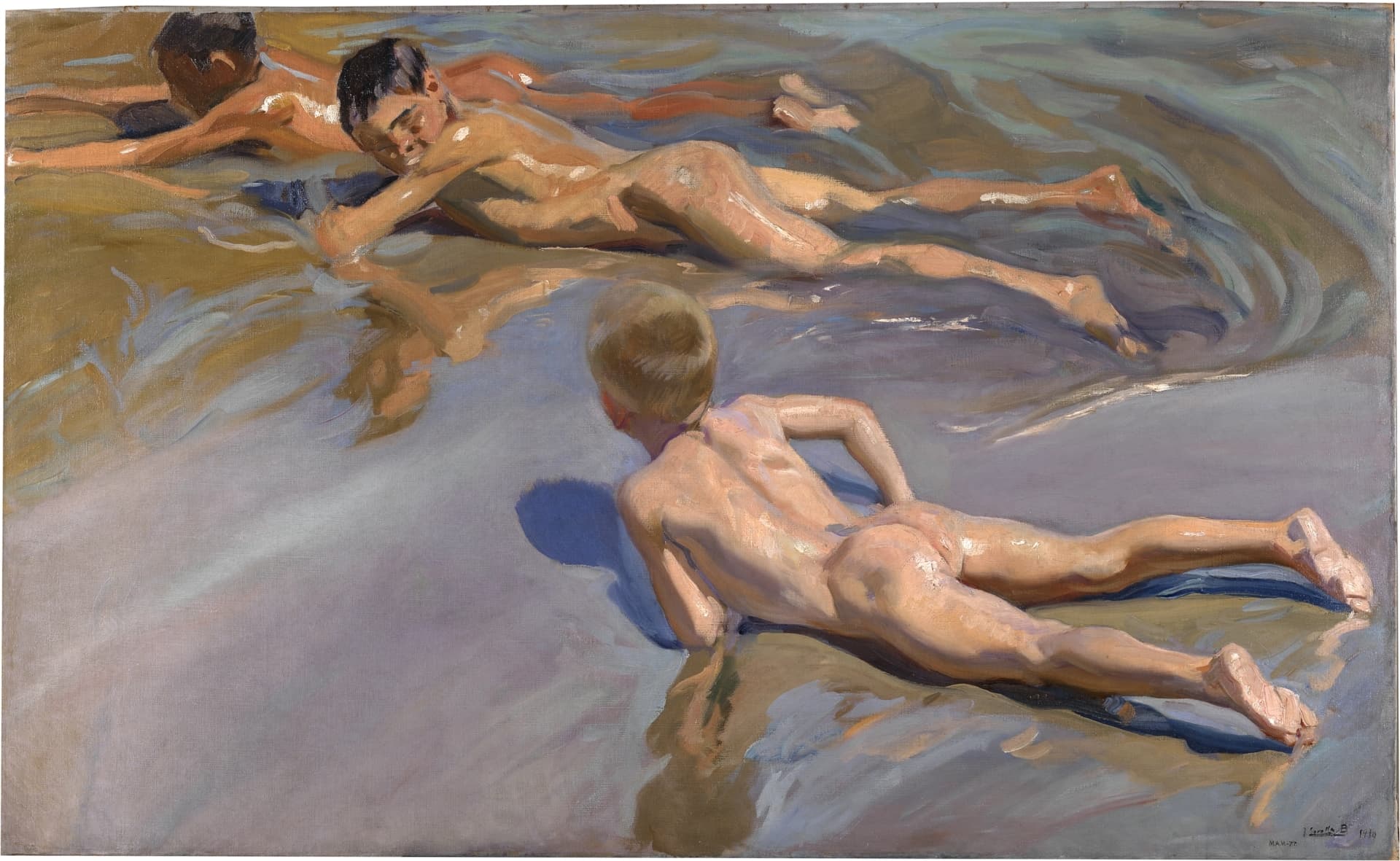
Boys on the Beach
When you first see this painting, your skin responds before your eyes do.
You can almost feel the warm sunlight, the texture of wet sand, and hear the splash of seawater.
Children run along the beach, bare and unguarded.
Not a care in the world — simply playing beneath the sun.
The scene feels so natural that you almost sense you are stealing a glance at a fleeting summer moment you happened to pass by.
This painting is a signature work by the Spanish painter Joaquín Sorolla.
It is also the work that best explains why he is called "the painter of light."
A Rare Impressionist in Spain
Sorolla was a remarkably rare Impressionist in Spain.
If Impressionism — born in France — placed its faith in light and the mood of the fleeting moment, Sorolla carved out his own world within that current.
Above all, he was a painter who loved the fierce Spanish sun more than anyone.
So when you look at his paintings, light is not merely illuminating the canvas.
Light itself feels like the painting's protagonist.
Painted on a Spanish Beach, in the Open Air
This work was painted at the Cabanyal beach in Valencia, Spain.
What is astonishing is that Sorolla painted this large-scale work directly on the actual beach.
Most large works of the era were completed in the studio, but Sorolla believed it was far more essential to paint under real sunlight.
Because light, as time passes, changes entirely.
So he stood on a scorching beach, swiftly chasing the ever-shifting colors of light as they transformed before his eyes.
Those who have visited Valencia may understand more keenly why the color in this painting feels so singular.
The sunlight there is extraordinarily bright, the sea is a vivid blue, and the sand reflects back in warm gold.
It is as if the light of the Mediterranean has been carried onto the canvas almost intact.
Light Flowing Over Water and Skin
Now look closely at the painting.
Sunlight spreads in bright white across the children's skin, while the seawater trembles continuously between blue and silver.
The shadows are even more remarkable.
They are not painted black.
Violet, blue, and grey are woven together within them.
Sorolla was not simply rendering light and dark — he was a painter who observed color itself as it transforms within light.
That is why his paintings, though depicting a frozen moment, feel as though they are perpetually in motion.
The waves, the sunlight, the children's bodies — all of it seems alive.
Why Did He Paint the Seaside So Often?
Beach scenes appear with striking frequency in Sorolla's body of work.
The reason was straightforward.
He knew that the beach was the place where his painterly vision could be expressed most fully.
The sea reflects light most intensely, and the human figure, water, sand, and sky are in ceaseless chromatic flux.
The beach was, in effect, Sorolla's finest studio.
And within that space, he spent a lifetime painting the Spanish sun and its summers.
This painting feels not like a simple landscape, but like a work that holds within it the very light of Spain.
To look at it is to share in the most radiant summer moment of someone's life.
And perhaps, Sorolla hoped that moment would never disappear.