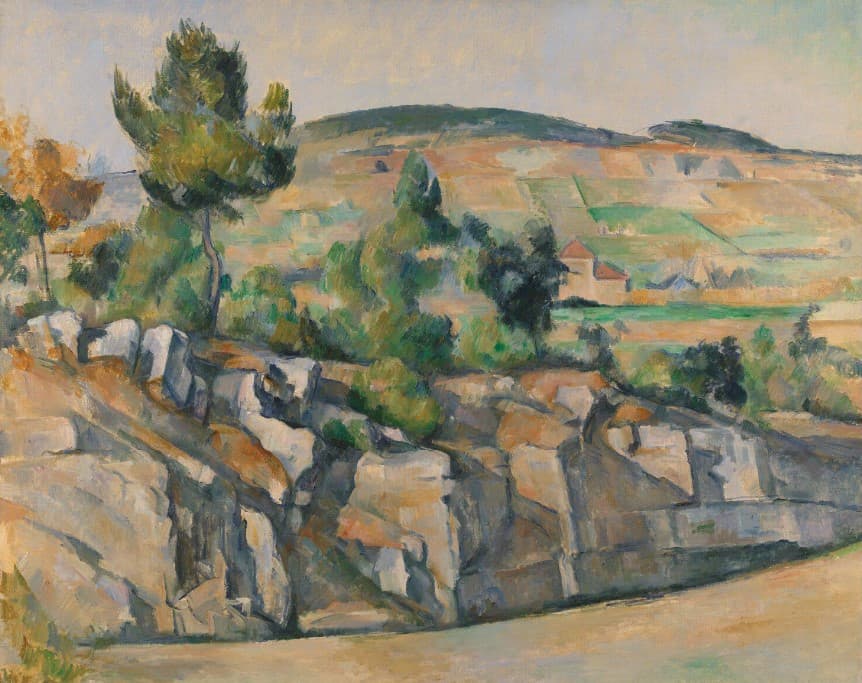
Hills in Provence
Paul Cézanne is the painter often called the starting point of modern painting in the twentieth century. And Pablo Picasso had this to say about him:
"Cézanne is my one and only master."
Why, among so many painters, did Picasso call Cézanne his master? Look slowly at the painting, and the answer begins to reveal itself.
An Obsession Hidden Inside an Ordinary Landscape
At first glance, this painting looks like nothing more than a quiet landscape. This is Aix-en-Provence — Cézanne's hometown.
Cézanne spent his entire life painting his hometown again and again. He gazed endlessly at its mountains and trees, its roads and fields, then looked once more. He regarded painting the landscape of his birthplace as the defining task of his life. Indeed, Cézanne was caught in a heavy downpour while painting outdoors, and his health deteriorated sharply afterward — he died not long after. Even in his final moments, he was standing before a canvas.
Why Cézanne Was Not an Impressionist
Cézanne was close to Claude Monet, Edgar Degas, and Pierre-Auguste Renoir, and he lived in the same era. Yet he is not classified as an Impressionist.
Why?
For the Impressionists, the paramount concern was light — the way it fell upon objects and the way it appeared to their eyes. What mattered was capturing that fleeting impression. In Monet's paintings, the atmosphere of light shifting with the time of day is the very heart of the work.
Cézanne's paintings are different. It is not easy to tell where the light enters the picture. Whether it comes from the upper right or rises from the lower left is difficult to pin down. Light is not the protagonist here.
Rather than the momentarily shifting light, Cézanne sought to see the "unchanging structure" that lay beyond it.
Cézanne Did Not Paint — He Constructed
Paul Cézanne was not content simply to transfer what he saw before him onto the canvas. He sought to reconstruct the essence and balance of things within the picture plane.
For this reason, he did not apply color as it literally appeared. He placed color according to the balance he envisioned for the composition. If he felt that balance was lost, he would stop working — or, it is said, destroy the canvas altogether.
This is why people say:
Cézanne was not a painter who "painted" — he was a painter who "built."
His landscapes are not mere nature. Mountains become mass, trees become structure, and the entire picture plane organizes itself like a single, solid work of architecture.
And So Picasso Called Cézanne His Master
The experiments Cézanne left behind would go on to exert an enormous influence on twentieth-century art. They proved a decisive point of departure especially for painters like Pablo Picasso, who sought to break subjects down into their forms and underlying structures.
Where Monet tried to seize "the visible moment," Cézanne tried to find the "unchanging order" concealed behind that moment.
That is why Cézanne's paintings may appear ordinary at first, but the longer you look, the less they feel like simple landscapes — and the more they feel like an experiment in understanding the world anew.