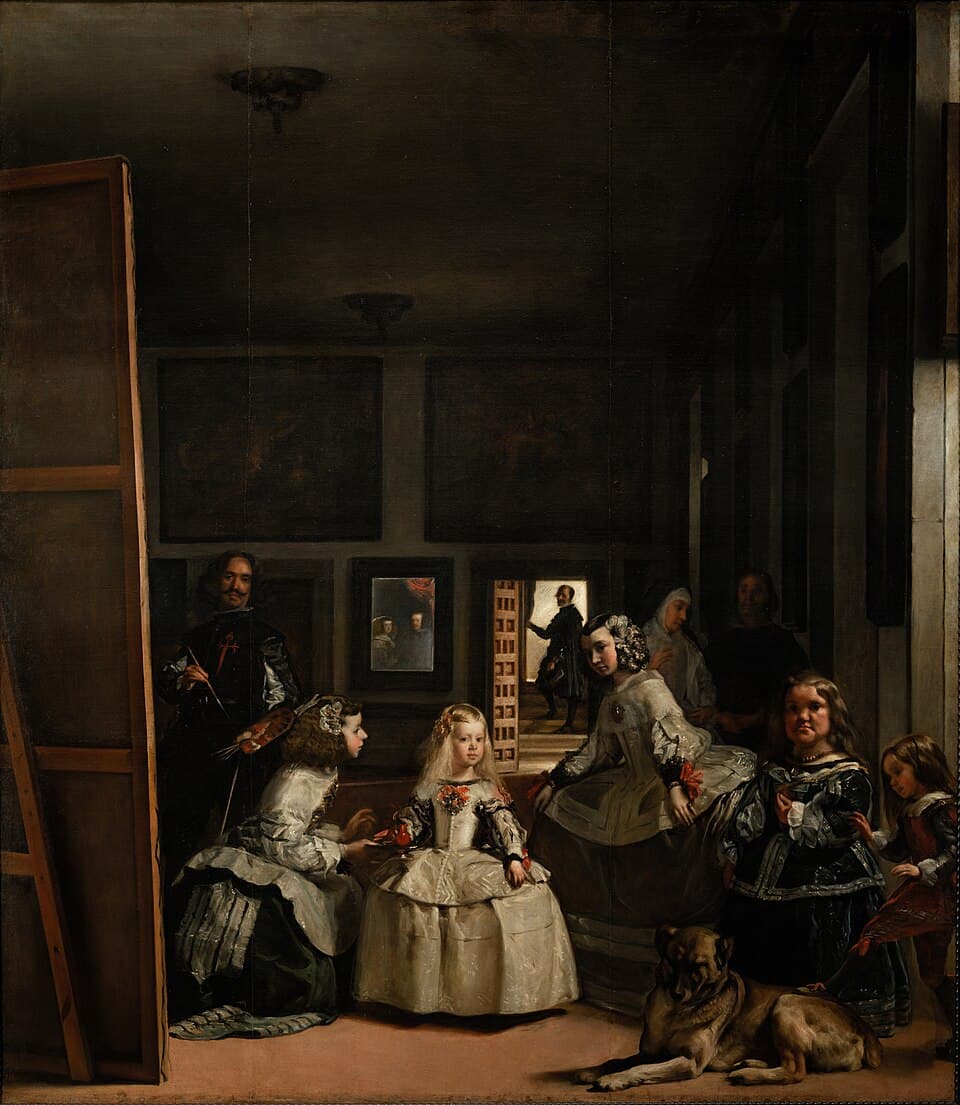
Las Meninas
The most bewildered person in this painting is the viewer. As you look at the picture, you will feel something strange.
Why is everyone looking at me?
The artist has placed the viewer in the positions of the king and queen. While appreciating the painting, at some point the viewer becomes a character within the picture.
A young girl in a golden dress stands in the center.
She is Princess Margarita Teresa.
She was the late-born daughter of the royal family who had lost an heir, and grew up receiving the love of the king and queen.
Perhaps for this reason, all gazes in the painting ultimately flow around her.
Please Look at the Dwarfs in the Painting
Dwarfs in court portraits were not mere decorations.
In the royal court at that time, they were positioned as jesters and sources of pleasure, and were often included in paintings to make the dignity of the royal family stand out even more.
A man standing before a canvas, brush in hand, gazing at us—who could he be?
It is none other than the painter Diego Velázquez himself.
Typically, court painters would paint from outside the scene, but Velázquez stepped into the painting itself. Like a declaration.
"I too am part of this world."
What He Truly Desired Until the End Was Recognition as a 'Nobleman'
The red cross on the painter's chest is the emblem of the Order of Santiago. At that time, this order was the highest symbol of authority that only those with pure noble bloodline could enter.
Velázquez was not originally a nobleman. He did not want to be recognized merely as a craftsman, but as a noble artist. Finally, at the age of 60, he was admitted to the order.
What's interesting is that when this painting was first completed, that cross was not there. Later, after becoming a member of the order, it is said that he himself painted that emblem over the picture.
He wanted to leave behind proof that he had finally reached the position he had always dreamed of.
Is it a Mirror, or Another Painting?
In the small mirror at the back of the painting, the couple of King Philip IV is reflected. Is it a mirror? Or is it another painting?
It is precisely this ambiguity that allows this work to be interpreted endlessly.
Are we viewing the painting through the king's gaze? Or are the figures in the painting looking back at us?
Countless painters have been captivated by this masterpiece.
Picasso in particular held onto this painting throughout his life. And he repainted it dozens of times over in his own style.
To that extent, this work was not merely a royal portrait.
Velázquez did not paint people, but rather cast the question 'what is painting?' onto the canvas itself.
That is why Las Meninas remains a strange painting even now.
The moment we think we are looking at a painting, the painting is already looking back at us.
