Leda and the Swan
Today, Even Zeus Got Lucky
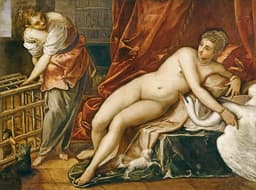
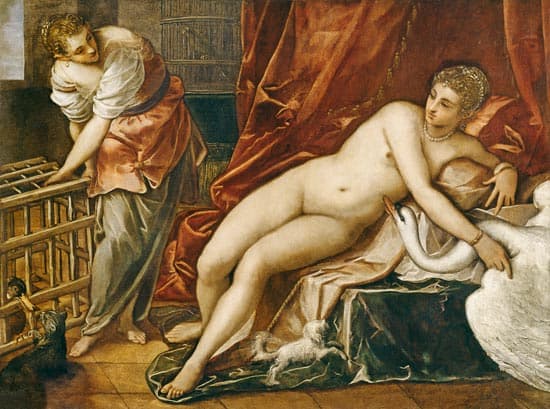
At first glance, the room in this painting feels a little noisy.
A crimson curtain hangs heavily, and the woman on the bed reclines with languid ease.
And yet the swan beside her is conspicuously agitated.
Leda, for her part, reaches out as if to calm the creature.
By now, you may have guessed.
Yes. That swan is no ordinary swan.
It is Zeus — the greatest philanderer in all of Greek mythology.
Whenever Zeus fell for a mortal woman, he delighted in disguise.
On one occasion he became a shower of golden rain; on another, a bull; and today, a swan.
If I were to give this painting a new title, I think I would call it something like this:
'Zeus's Lucky Day.'
In the myth, despite all this commotion, Zeus and Leda do become lovers. They produce two sons and two daughters. The twin sons will one day become the Dioscuri, the constellation in the night sky, and one of the daughters is none other than the famous Helen — the most beautiful woman in the world, whose face launched the Trojan War.
Seen in that light, a single encounter in this modest little room ultimately sets the entire Greek world trembling.
Why Did Tintoretto Paint It So Dramatically?
Tintoretto was one of the defining painters of Venice, alongside Titian and Veronese.
In terms of chronology, however, he was the latest of the three.
He belonged to the age of Mannerism — a period that followed the balance and serenity of the Renaissance and favored more exaggerated, theatrical expression.
And so his paintings are always in motion.
In this work too, Leda stretches diagonally across the canvas, the handmaid twists her body with dynamic energy, and a crimson curtain cuts between them in a V-shape.
The eye is drawn naturally through the composition.
Many Mannerist painters of the era employed this kind of diagonal structure.
But Tintoretto was a little different.
He used this kind of composition not merely to look impressive, but to deliver the story with greater dramatic force.
As a result, a Tintoretto painting reads like a scene from a film.
The Most Human of the Venetian Painters
This is precisely why I have a personal fondness for Tintoretto.
He was a painter who composed his scenes with exceptional generosity, making them readily accessible to the viewer.
Perhaps that had something to do with the life he led.
Titian and Veronese were painters of popes, emperors, and nobles; Tintoretto was, by comparison, a painter of the people.
He spent long years competing in the shadow of two already towering reputations, and painted without pause to support his family.
He would even tell patrons, if they wished, that he could paint in the manner of Titian.
Livelihood mattered more than pride.
In return, he painted faster than anyone, and produced more work than anyone.
He left an enormous body of work centered on the city's educated commoner class, the Venetian confraternity halls known as the Scuole, and the parish churches of the city.
Travel through Venice and you will find yourself encountering Tintoretto far more often than you might expect.
Perhaps he was, more than anyone, the painter who stayed closest to ordinary people.
And this painting, too, borrows the story of a god from myth only to render, with vivid immediacy, the very human desires and disorder that lie beneath.