The Garden of Earthly Delights
This painting is ominous even when closed
You have likely never seen a painting quite like this.
As you look at it, you cannot tell whether you are in a dream or a nightmare.
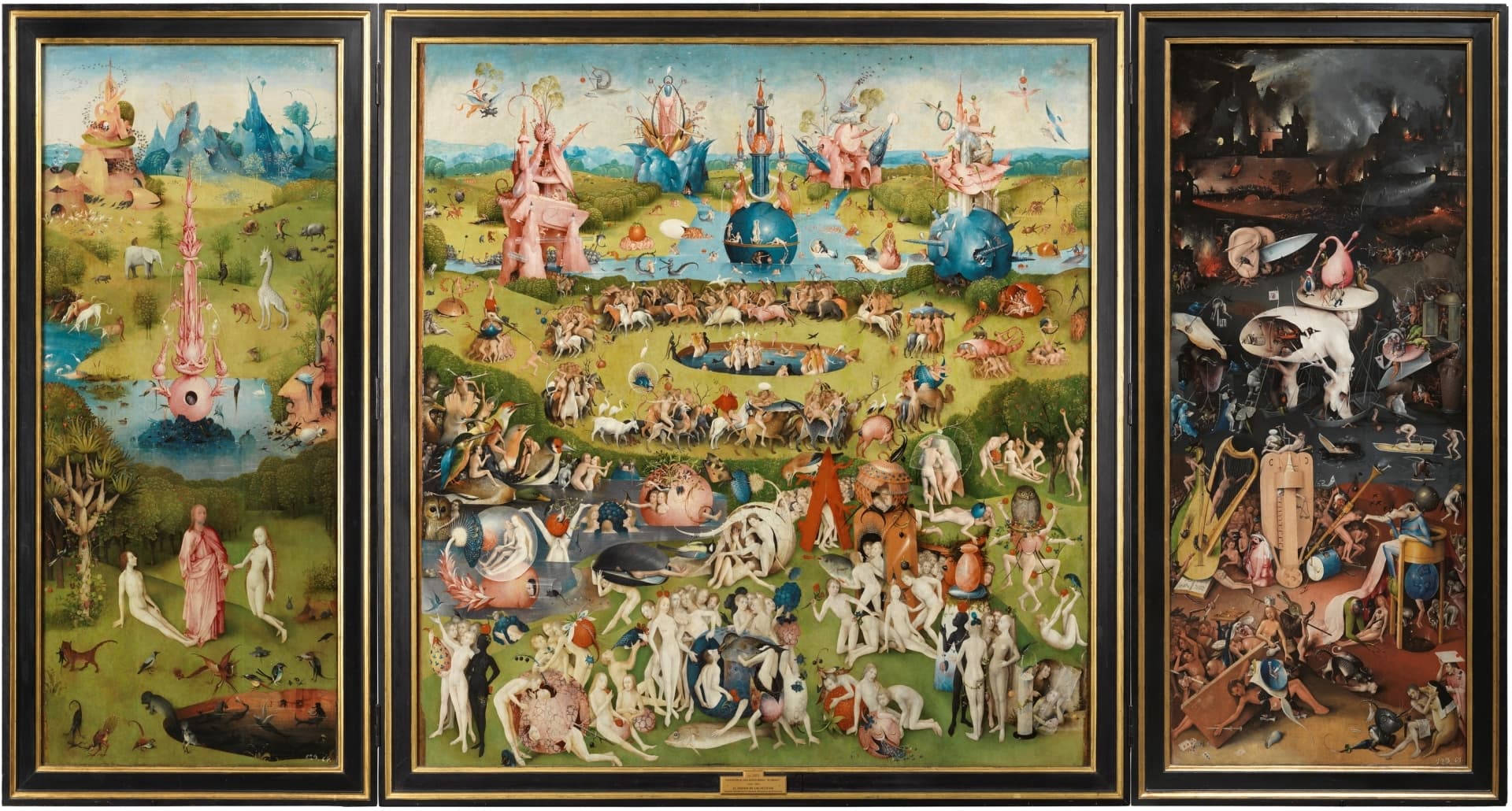
Humans and animals are intermingled, enormous fruits drift through the air, and figures writhe in torment atop musical instruments.
Yet the painting's true beginning is not the open panels you see before you.
You must first close the painting.
This work is a triptych altarpiece.
Designed for use in a church, its two outer panels fold open and shut.
And when the panels are closed, an entirely different scene appears.
A gray, spherical Earth.
No sun yet. No moon. No living creatures.
It is the third day of Creation, as the world takes shape at God's hand.
Now look closely at the upper left.
You will find a small, painted face — God himself.
But the expression is unsettling.
The corners of the mouth are turned ever so slightly downward.
It is the face of someone who already knows what is about to unfold.
Even in the Garden of Eden, the devil was already hiding
This work tells its story from left to right.
So let us follow it, beginning at the left.
Here, God is introducing Eve to Adam.
Look at Adam's expression.
He wears the startled look of someone encountering a being who resembles him and yet is utterly unlike him.
At the center flows the water of life, and around it every manner of animal and plant coexists in peace.
A perfect paradise. The Garden of Eden.
Yet in Bosch's world, even heaven is not entirely safe.
Look carefully at the lower right.
A strange creature is lurking in the pond.
A bird's beak, a fish's body, draped in a black cloak and reading a book — a grotesque figure.
It is Satan.
Bosch seems to be saying something here.
That evil had entered the world from the very beginning.
And from this point, the painting begins to spiral into madness.
The human world ultimately fills with pleasure
We come now to the central panel.
The pure atmosphere of before has vanished entirely.
Figures tangle together in heaps; fruits have swollen to grotesque proportions; humans riding animals race endlessly in circles.
The great streams flowing at the top of the panel are the four rivers of Scripture.
This, in other words, is the real world — the world of humankind.
In the central pond, countless women bathe, while men mounted on animals circle endlessly around them.
In the iconography of the time, a man riding an animal was commonly read as a sexual symbol.
This scene, then, is a pageant of human desire.
And look toward the bottom.
Red fruits — cherries, strawberries — are painted far larger than any human figure.
In the medieval imagination, such fruits symbolized greed and carnal pleasure.
Desire has grown larger than humanity itself.
Happiness shatters like glass
Look closely to the left, and you will find a man and woman playing inside a transparent glass orb.
But the glass is cracked.
This is a scene drawn from a Flemish proverb.
"Happiness is as fragile as glass."
Bosch is showing us just how unstable the pleasures and happiness that humans grasp for truly are.
And if you look beneath the flowers nearby, a mouse is crawling into a glass tube.
The glass tube symbolizes the male sexual organ, and the mouse represents the evil that seduces humankind.
The painting, in its entirety, speaks ceaselessly of human desire and corruption.
Scholars continue to debate the central panel to this day.
Is this a paradise where humans freely indulge their desires, or a world already fallen beyond redemption?
But at least one thing is clear.
At the end of all this chaos and pleasure, Hell on the right panel is waiting — without fail.
Hell is performed on instruments built by human hands
We come now to the final panel: Hell.
The first thing to catch the eye is a colossal harp.
A figure is bound to its strings, forced to be played as an instrument himself.
In life, this person surrendered to music and sensual pleasure; in death, he is condemned to be played upon without end.
And nearby, a sheet of music appears.
Remarkably, a modern musician once deciphered and performed this score.
And the result, it is said, was a strikingly coherent piece of music.
Bosch was a painter who imagined even Hell with a detail bordering on the uncanny.
To the right, a blue monster is devouring human figures.
Those consumed fall into a pit below.
There, the souls guilty of greed, gluttony, and debauchery receive their punishments.
One figure excretes coins — the punishment for greed; another vomits endlessly — the punishment for gluttony.
Hell, in the end, is nothing more than the consequence of the desires humans pursued in life.
Why did Bosch place his own face in Hell?
Now look to the center of the panel.
You will see a vast figure with a body like a cracked eggshell, legs like bare tree trunks, and a human face.
That face is none other than the painter Bosch himself.
Why would he deliberately place himself in Hell?
The answer lies within the body.
Inside the shell is a tavern where demons rest and drink.
Bosch, by all accounts, was a man who loved drink greatly.
This scene, then, amounts to a confession: "I, too, am not free from desire."
Rather than simply condemning others, Bosch includes himself within the realm of sin.
That is precisely why Bosch's painting is all the more unsettling.
It does not feel like someone else's story — it feels like the story of all of us.
Why did God gaze down upon the world with a look of disappointment?
Cast your mind back to the beginning.
The closed panels, and the face of God looking out upon a world not yet made.
Why that expression of disappointment?
Perhaps Bosch wished to say that God already knew.
That humanity would, in the end, live on in an endless cycle of desire and transgression.
Even so, this painting is not simply a condemnation of humankind.
If anything, Bosch was a painter who understood — far too well — what it meant to be a creature of desire.
That is why his paintings feel no less immediate five hundred years on.
The world has changed, but human beings remain very much the same.