The Third of May 1808
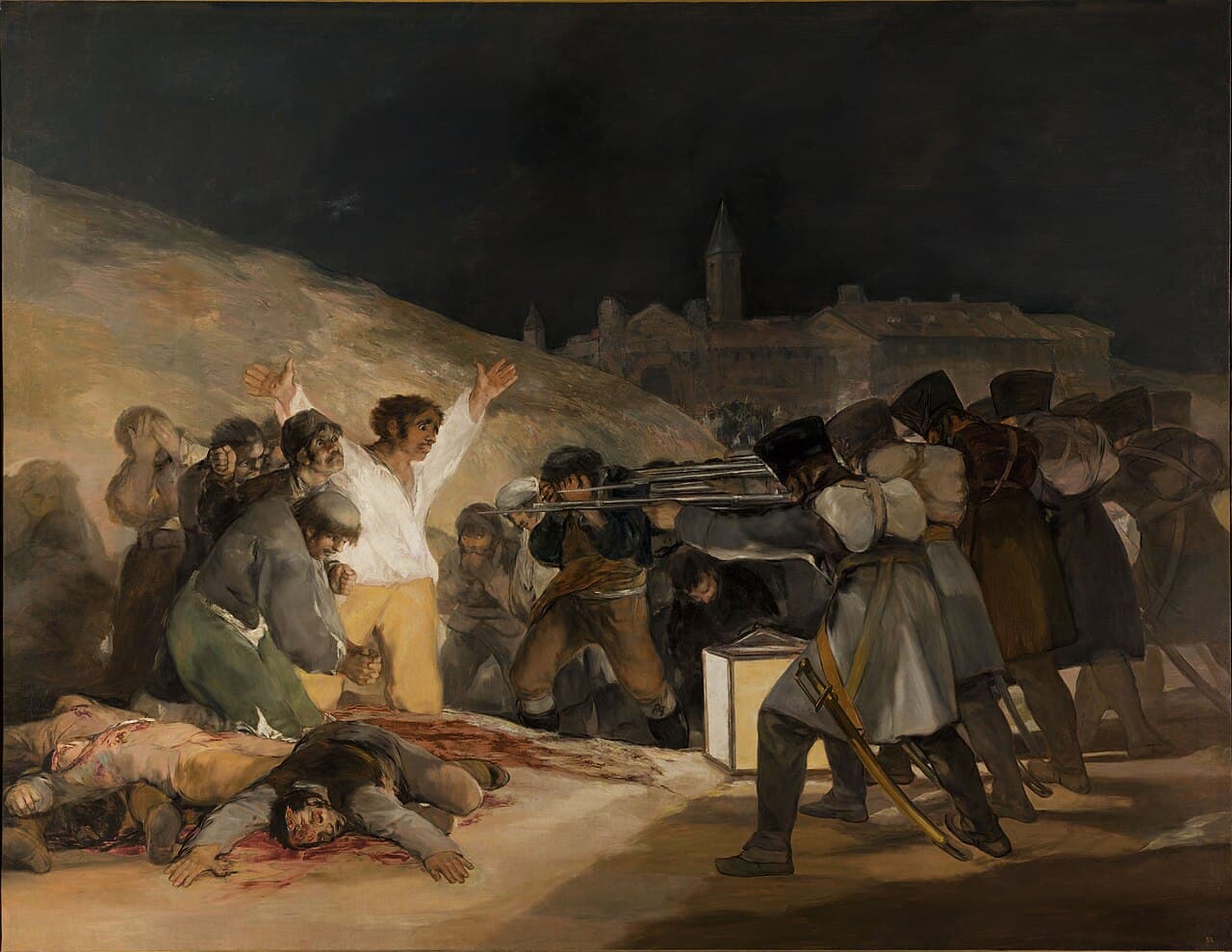
The man in white at the center of the painting
stands with his arms thrown wide open, facing the muzzles of French rifles. A tension that feels as though gunshots could ring out at any moment fills the entire canvas.
To his left, those already executed have collapsed to the ground, their blood spreading across the earth. Behind him, others who await their own turn stand with faces buried in their hands or heads bowed in dread.
It is a painting that captures the terror of ordinary people standing before the machinery of war.
Soldiers Without Faces
Now turn your attention to the French soldiers on the right.
They all hold their rifles in an identical stance, yet not a single face is visible.
They are rendered as a single machine — one that executes orders without emotion.
The condemned civilians, by contrast, each bear a different expression and posture: some trembling with fear, some at prayer, some meeting death with quiet resignation.
By setting these two groups in stark opposition, Goya shows us how war strips away our humanity.
A Symbol of Hope
The figure who commands the eye above all is, again, the man in white.
His outstretched arms inevitably call to mind Christ crucified on the cross. Look closely and you will notice small wounds on his palms — marks that evoke the stigmata of the nails.
Goya paints this man not as a mere victim but as a figure who embodies human dignity even in the face of unjust violence.
This is why the work is regarded as far more than a record of an execution — it stands as a searing indictment of war and brutality.
That Day in History
The painting is rooted in an event that actually took place in Madrid on the third of May, 1808.
At the time, Spain had been drawn under the influence of the French forces led by Napoleon. As French troops garrisoned cities and towns across the country, civilian resentment mounted steadily, until on the second of May a large-scale uprising erupted in Madrid.
But the resistance did not last long.
The following day — the third of May — French forces rounded up those who had taken part in the revolt and carried out public executions.
It was precisely that moment that Goya committed to canvas. He painted no heroic triumph, no glory of war — only the ordinary people who pay the heaviest price when war descends upon them.