Ugolino and His Sons
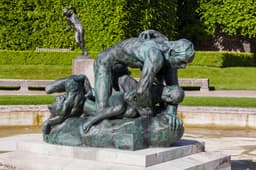
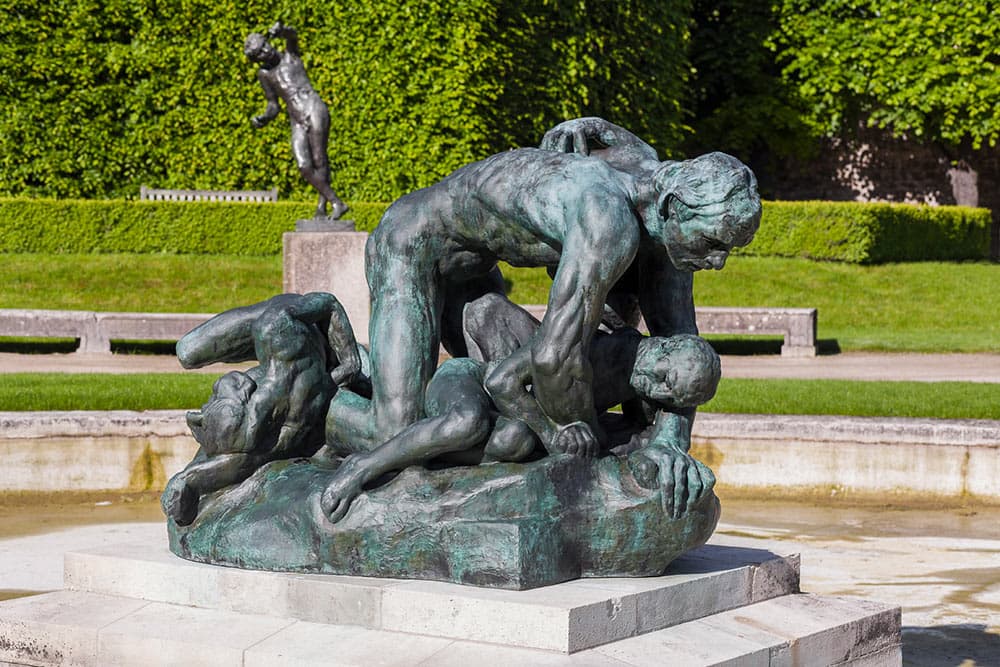
This work is Rodin's 〈Ugolino and His Sons〉.
The work is based on a tragic story from Dante's Divine Comedy.
The sculpture's subject, Ugolino, was a real historical figure — the ruler of Pisa in thirteenth-century Italy. At the time, Italy was gripped by relentless conflict between factions supporting the Pope and those loyal to the Holy Roman Emperor.
After a prolonged political struggle, Ugolino was captured by his enemies and imprisoned in a tower along with his two sons and two grandsons. The door was sealed shut, and all food was cut off.
As time wore on, the hunger became unbearable. In his despair, Ugolino began to bite his own hands, losing all reason. Witnessing their father's anguish, the children begged him to eat them instead — yet Ugolino, in the end, could bring himself to do nothing.
One by one, his family members starved to death, and Ugolino himself eventually perished from extreme hunger. Because Dante described the final moments in deliberately ambiguous terms, debate continues to this day over whether Ugolino actually resorted to cannibalism.
Man or Beast?
Let us look closely at the sculpture.
Barely any flesh remains on the body — bone and sinew are laid bare. The posture, crouched low as if crawling on all fours, evokes not a man but a predatory beast.
Rodin sought to capture the collapse of humanity in the face of extreme starvation — to fix in stone the precise moment when the boundary between human and animal dissolves under agonizing despair.
The sculpture is installed at the center of a pond, making it difficult to approach closely, but looking at the face one finds the mouth half open, the gaze utterly vacant. The expression — as though all reason has been extinguished — leaves a lasting impression.
Rodin's Relentless Observation
There is a well-known anecdote attached to this work.
Rodin frequently worked from live models in order to capture genuine emotion. When sculpting Ugolino, it is said he searched at length for a sitter whose face carried something close to madness, and observed him over an extended period.
Rodin would later recall of that man: "He was not a person — he was like a wolf."
His intention was to study a real human being and transfer the most extreme reaches of human emotion into stone.
One senses that Rodin was not merely sculpting the human body, but striving to embed within the stone itself the psychology of a man disintegrating under absolute despair.