Venus and Mars
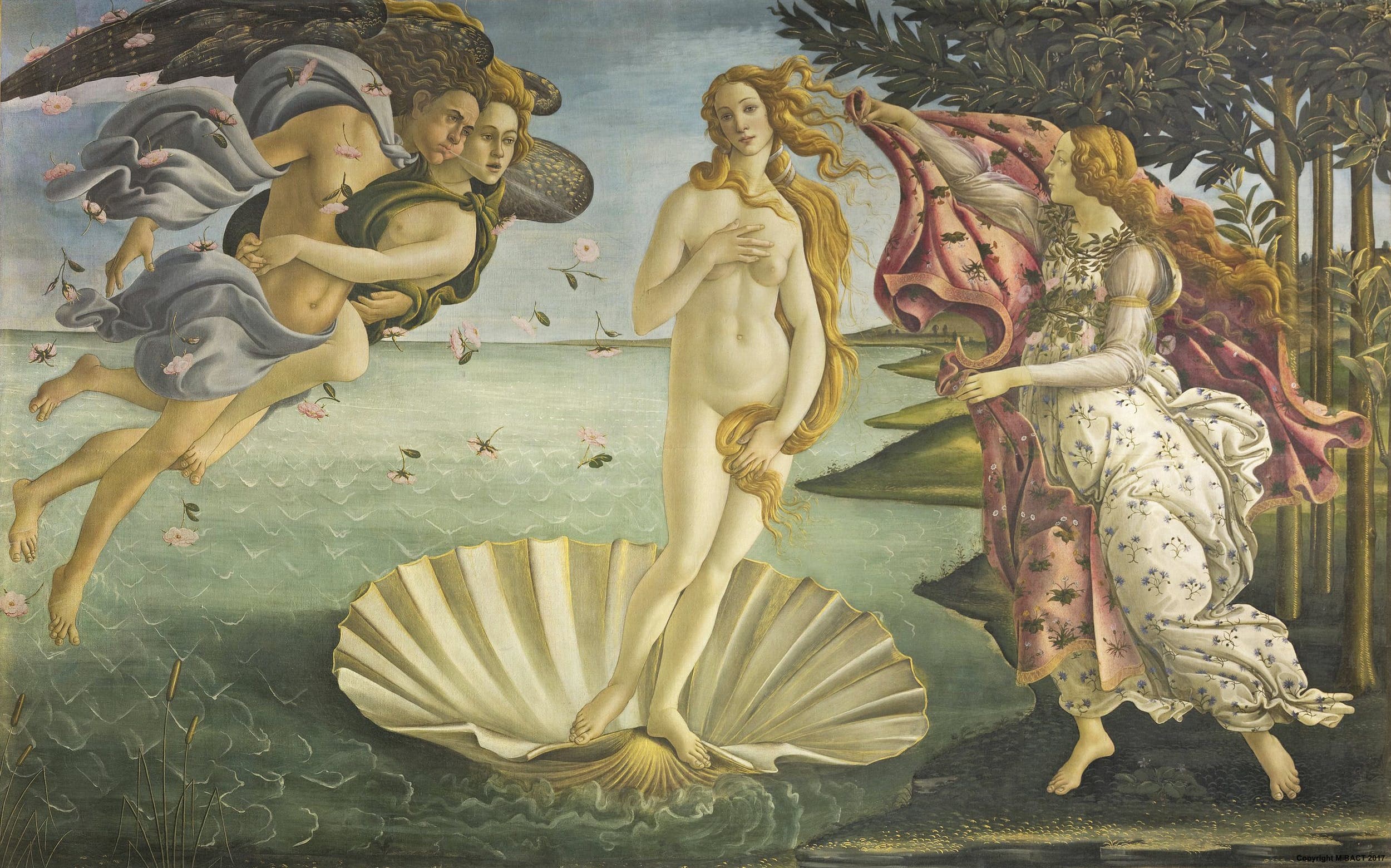
Begin by looking at the center of the painting.
A woman stands upon a scallop shell. She is Venus, goddess of love and beauty.
According to Greek mythology, Venus was born from the foam of the sea. Botticelli painted precisely that mythological moment.
Venus has just revealed herself to the world, yet her expression is remarkably serene. Her body turns in a gentle twist that naturally conceals what modesty requires — a pose drawn from the ancient Greek sculptural tradition as an expression of ideal beauty.
The Wind Arrives
Now look to the left side of the painting.
Two figures blow with all their breath, propelling Venus toward the shore.
The male figure is Zephyrus, god of the west wind, and the woman cradled in his arms is understood to be a spirit of spring.
The wind the two create together moves Venus's hair, the drapery, and even the sea itself in a single, unified direction.
This is why, despite being a static image, the painting feels as though the wind is genuinely blowing.
A New Beginning
On the right, a woman in a flower-patterned robe waits to receive Venus.
She is one of the Horae, goddesses of the seasons, and she stands ready to drape a magnificent cloak around Venus's shoulders.
It is the moment Venus, born of the sea, steps into the mortal world.
The painting, then, is not merely the birth of a goddess — it captures the very instant that beauty and love arrive in the world.
Beauty as Botticelli Saw It
Botticelli is one of the defining painters of the Early Renaissance.
Yet he valued the graceful line and beauty of his figures above strict perspective or anatomical precision.
Venus's long neck, her hair flowing in soft waves, and her arms and torso that appear slightly elongated beyond life — all of these were deliberate choices in the pursuit of an idealized beauty.
Many have also suggested that Venus's face was modeled on Simonetta Vespucci, celebrated as the greatest beauty in Florence of her day. There is no definitive record to confirm it, but the story endures — not least because Botticelli returned to the same face, again and again, across several works.
An Emblem of the Renaissance
In the Middle Ages, it was virtually unheard of to paint mythological subjects on such a grand scale.
As the Renaissance took hold, however, people turned once again to the cultures of ancient Greece and Rome — and it was within that current that Botticelli brought this work into being.
The Birth of Venus is therefore regarded not simply as a painting of a beautiful goddess, but as a work that embodies the Renaissance ideals of human beauty and the revival of classical culture.
Take a moment to look at Venus's face.
More than five hundred years have passed, yet the vision of ideal beauty that Botticelli held in his mind continues to hold the gaze of all who encounter it.