Whistlejacket
Let us begin by taking in the painting as a whole.
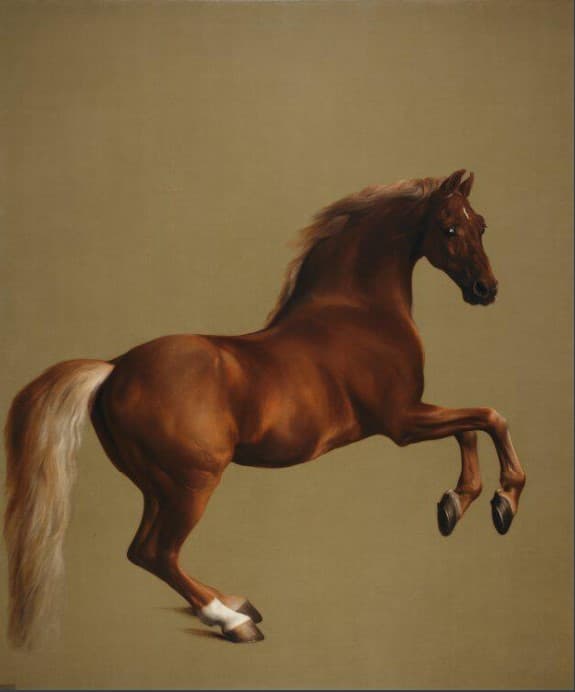
A horse nearly life-size fills the entire canvas. There is no background, no human figure — only a single horse standing before us.
The subject of this work is a racehorse named Whistlejacket.
Whistlejacket was a horse of exceptional breeding, celebrated in his day as a remarkable competitor on the track. Even after his retirement, his beauty was such that his owner, the Marquess of Rockingham, commissioned the painter George Stubbs to immortalize him on canvas.
An Image of Freedom
Look closely now at the horse's body.
There is no saddle, no bridle. Not a trace of human presence.
Whistlejacket rears up, forelegs lifted high in a surge of power — yet he is bound to nothing.
One cannot help but feel that this retired racehorse has, at last, reclaimed his freedom.
A Horse with Expression
Now turn your attention to the face.
The ears are pricked, the eyes alive with alertness.
There is a palpable tension — as though the horse might move at any moment.
In the eighteenth century, it was unusual to paint an animal in this way. Most painters rendered horses as animals, pure and simple; Stubbs captured something more — the individual character and personality of a particular being named Whistlejacket.
This painting, then, is less a depiction of a horse than it is a portrait of a singular presence.
A Painter Who Observed Nature
Stubbs's ability to paint with such conviction grew from a relentless dedication to observation.
He did not confine himself to copying other painters' work in the studio. He observed horses directly, dissected them, and studied the mechanics of muscle and bone in motion — going so far as to produce a treatise, The Anatomy of the Horse.
It is this rigor that allows Whistlejacket's body to convey something beyond mere beauty of form — the raw force and movement of a living creature.