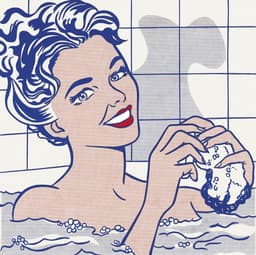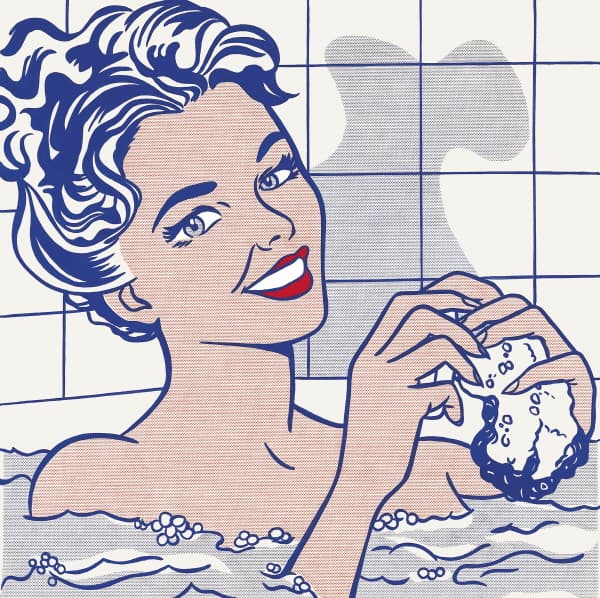
Woman in Bath
A woman is smiling in the bathtub.
Her hair is perfectly curled, her skin unmarked by a single shadow.
Soap bubbles cling to her fingertips.
And yet something feels off.
It is a warm bathroom scene,
yet it reads as cold — clinical, like an advertisement.
That unsettling sensation is precisely what lies at the heart of Roy Lichtenstein's painting.
It Looks Like a Comic Strip — but It Is, in Fact, a Modern Portrait
Look closely at this work.
The skin has almost no sense of volume or depth.
What fills the canvas instead are regular lines and dots, and bold cartoon-like contours.
The Tiny Dots You Notice Up Close
Look especially at the face and the background:
small dots repeat across the surface, just as they would in a printed magazine.
This is Lichtenstein's signature Ben-Day dots technique.
It was originally a printing method used in newspapers and comic books to reproduce color cheaply and efficiently.
Yet he took that commercial technique
and brought it directly into the realm of monumental painting.
What makes this fascinating is that while the image looks as though it were stamped out by a machine,
every mark was in fact made entirely by hand.
Every single dot included.
His paintings therefore produce a peculiar collision of opposites.
Handmade, yet cold.
A painting, yet it looks like an advertisement.
A person, yet she appears almost like a product.
Enlarging the Beauty Found in Advertising, Exactly as It Is
The 1960s in America were an era of explosive growth in advertising and mass media.
The perfect smile on television, the idealized woman in the magazine, images consumed without end.
Lichtenstein was painting precisely that "manufactured beauty" for all to see.
And so the woman's smile does not simply read as happiness.
It feels, instead, like an idealized scene someone else has constructed.
Much like the moment we gaze at an image in an advertisement
and are made to believe: "This is what beauty looks like."
"Is This Really Art?"
At the time, many people looked at his paintings and asked,
"Is this really art?"
It seemed like a copy of a comic strip,
and it looked as trivial as an advertisement.
Looking back now, however, the opposite seems true.
Lichtenstein had long foreseen the age in which we would live our daily lives immersed in social media feeds and advertising images.