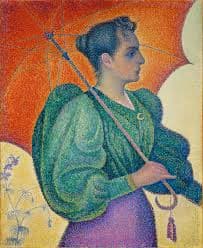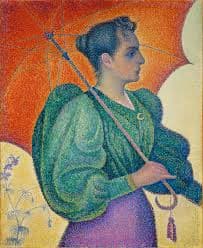
Woman with a Parasol
The first thing that catches your eye when you look at this painting is its vivid color.
A bold red parasol, a green blouse, and a violet skirt — each color feels distinctly alive.
The model for this painting is Signac's wife, Berthe Roblès.
Signac completed this work almost as an experiment — a demonstration of how beautifully colors can harmonize with one another.
A Painting of Order
There is also a strong sense of composure and order to the composition.
The figure stands squarely upright, and the flowers and decorative elements in the background are arranged with regularity.
The ornament at the tip of the parasol and the floral motif at the lower left introduce a sense of rhythm into a composition that might otherwise feel rigid.
Every element holds its calculated place, achieving a precise equilibrium.
How Does It Differ from Monet?
This work naturally calls to mind Monet's Woman with a Parasol.
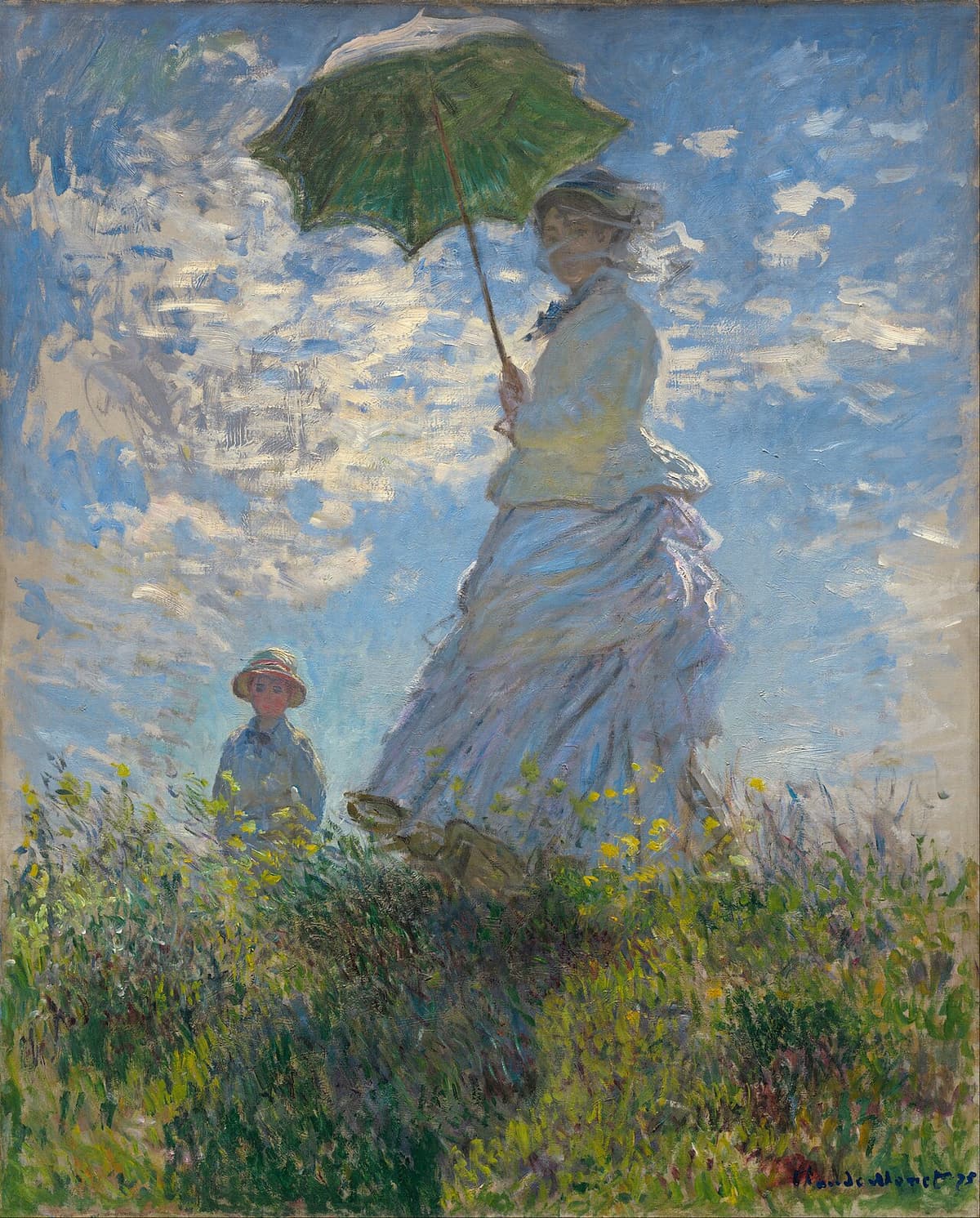
Both works depict a woman holding a parasol, yet the mood could hardly be more different.
Monet captured a fleeting instant of wind passing through — the grass sways, the clothing moves, and the moment feels vibrantly alive.
Signac's painting, by contrast, feels as though time has come to a standstill.
The figure stands in quiet repose, and the entire picture surface is organized with deliberate order.
This difference is precisely what separates Impressionism from Neo-Impressionism.
Where Impressionism sought to capture the light and movement of a passing moment, Neo-Impressionism aspired to express an enduring beauty through the harmony of order and color.
To that end, Signac patiently built up small dots of color, unifying the entire surface into a single, coherent order.
Thanks to its vivid colors and composed surface, this is a painting that reveals new harmonies and new beauty the longer you look at it.