Dancer in Green
Take a moment to look at the painting slowly.
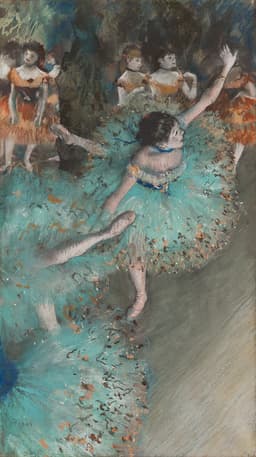
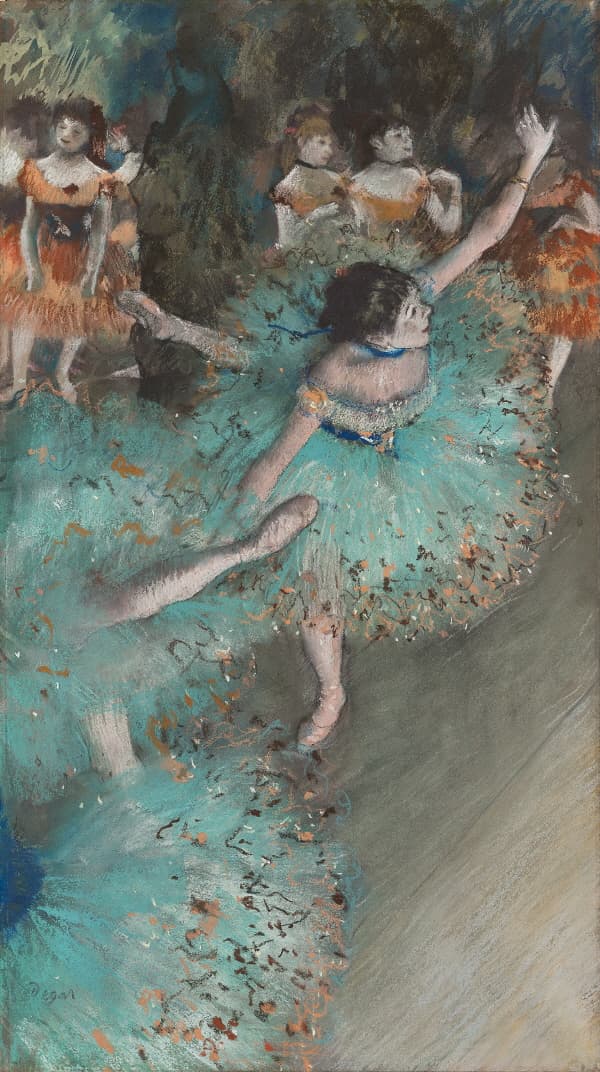
Three ballerinas in green costumes are the first thing to catch your eye. But doesn't something feel a little unusual? It is almost as if you are looking down from near the ceiling rather than from a seat in the audience.
Degas often employed this kind of unconventional vantage point. Because of it, we experience the painting not as spectators watching a performance, but as someone present inside the rehearsal room itself.
The Eye Follows
Now look at the ballerina in the upper right.
You can see her arms spread wide. Follow those arms and your gaze flows naturally to the leg of the dancer beside her, and then down to the hint of a green skirt visible at the lower edge.
Degas connected the figures' movements in just this way, guiding our eyes to wander slowly through the composition.
A Bright Stage, a Dark Studio
The back of the picture feels slightly cramped. The dancers are clustered together, and the colors are a touch darker.
The stage in the foreground, by contrast, is empty and bathed in brilliant light.
The lives of ballerinas at the time were harder than we might imagine. They had to train relentlessly, and opportunities to perform on stage were far from plentiful.
By painting the dim rehearsal room alongside the luminous stage, Degas captured both reality and dream within a single image.
Why the Light Is So Beautiful
There is a reason this painting feels unusually soft and warm.
Degas worked with pastel and gouache together. This allowed him to render the stage lighting as a gentle, diffused glow, and to bring the ballerinas' movements to life with an airy lightness.
Before the Curtain Rises
Degas was more drawn to the time of preparation than to the height of performance itself.
And so this painting holds both tension and anticipation.
Linger a moment before the work and look at the faces of the ballerinas.
What might those about to take the stage have been feeling in this very moment?