Women Ironing
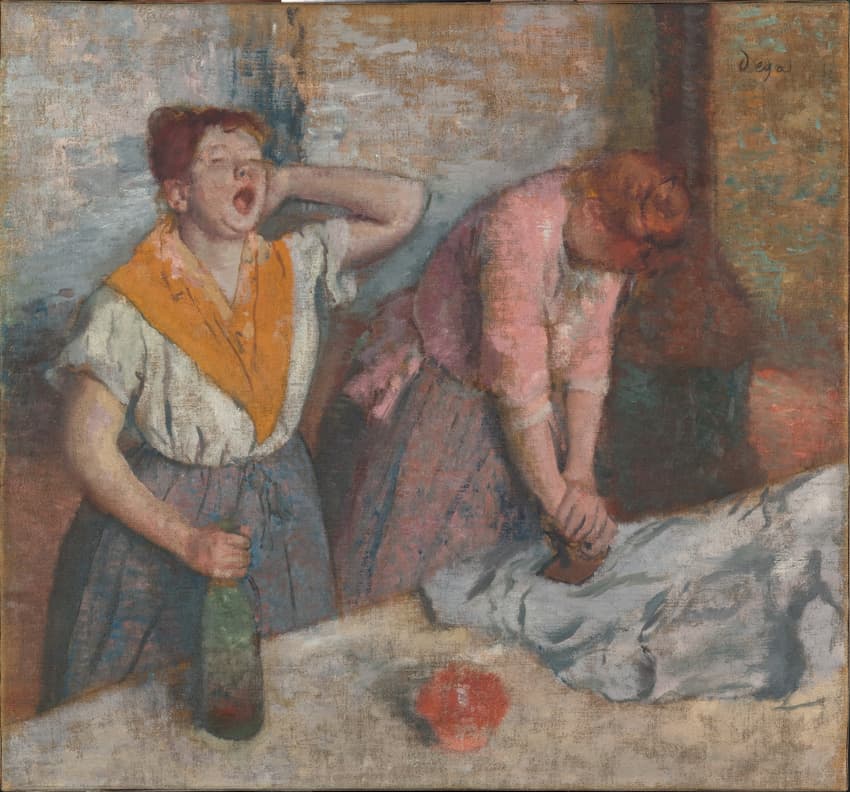
The painting shows two women.
The woman on the right is focused on ironing — leaning forward, pressing down with her full weight.
The woman on the left, meanwhile, is caught mid-yawn, a bottle of wine in one hand, taking a brief rest.
They share the same space, yet the atmosphere surrounding each could not be more different.
You Can Feel the Weight of the Day
Degas rendered the two figures with strikingly contrasting gestures.
The working woman's shoulders are raised and her entire body is taut with effort. The resting woman, by contrast, is entirely slack, every last trace of tension drained away.
No caption is needed — the exhaustion of a full day's labor communicates itself naturally.
In nineteenth-century Paris, laundresses were a common sight on the streets. Degas returned to the everyday lives of ordinary people far more often than to any glittering stage.
Why He Chose Rough Cloth
Move in a little closer and study the surface of the painting.
In places across the background, the brown ground shows through bare. Rather than a smoothly primed canvas, Degas used a support that still carries its raw, coarse texture.
Curiously, against that rough ground the laundresses' clothing appears all the brighter and softer.
The pastel-toned garments and skin, in particular, seem to glow with a quiet warmth.
Making the Ordinary Extraordinary
Degas made no effort to glamorize the act of washing and ironing.
He recorded the weary expression and the stolen moment of rest exactly as they were.
That is why this work feels less like a simple depiction of laundresses and more like a document of people quietly living out their days.
Take a moment to look at the two women's faces.
Perhaps even now, 150 years on, the fatigue of reaching the end of a day has not changed so very much.