Berlioz's House
The Painter Who Captured the Melancholy of Montmartre
Let us begin with a brief introduction to the painter Maurice Utrillo.
Utrillo was born in the Montmartre district of Paris,
and spent his entire life painting Montmartre and its surrounding streets.
His mother was none other than
Suzanne Valadon, celebrated as the muse of the Impressionist painters.
Yet Utrillo grew up never knowing who his father was.
Because Suzanne Valadon had lived freely in love, his paternity remained unknown,
and that uncertainty left a deep mark on Utrillo's inner life from childhood.
He struggled with severe alcoholism from his teenage years.
And it was during that very period
that he took up painting, at his mother's urging.
Though he was condemned to live his entire life amid drink and anxiety,
as a painter he ultimately received the Légion d'honneur, France's highest decoration.
Perhaps painting was the one place
that held him together to the very end.
A Dreary Street and a White Wall
Now let us turn to the painting itself.
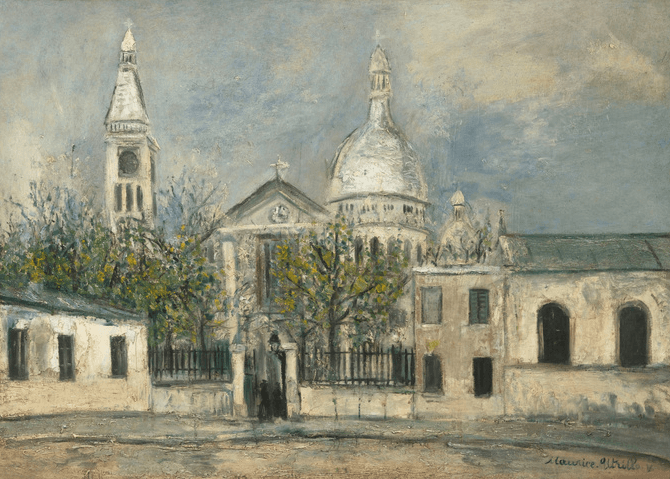
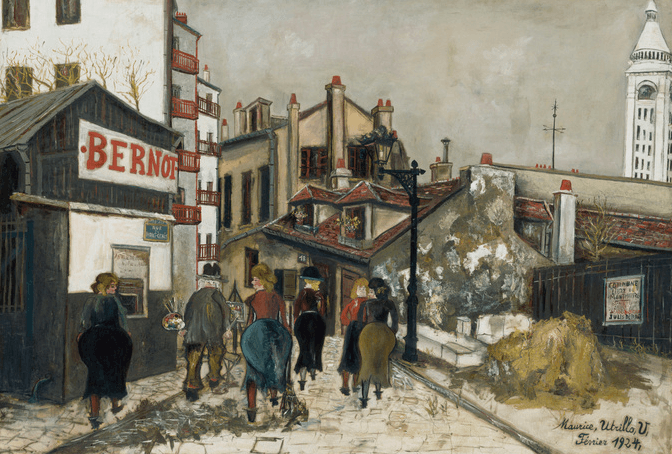
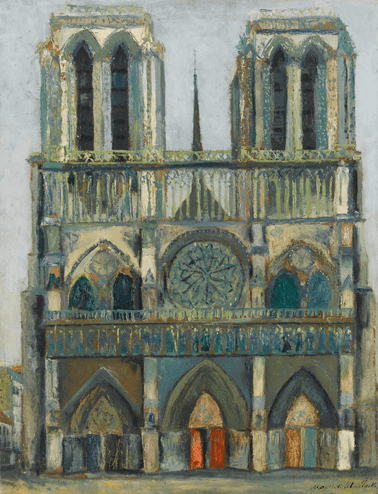
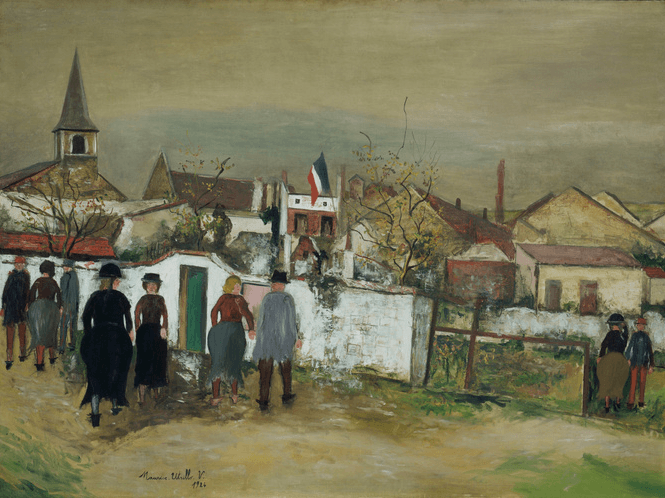
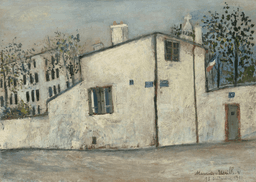
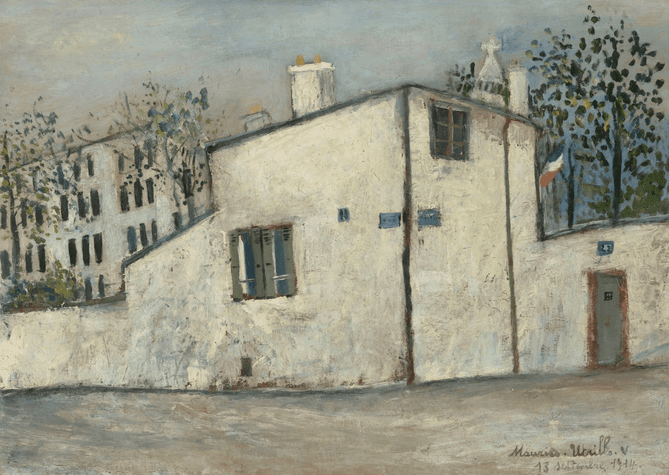
The house depicted here is the one in Montmartre where the composer Berlioz once lived.
This work is also considered a defining example of Utrillo's so-called "White Period."
The paintings of this era are suffused throughout with grey tones,
and carry an atmosphere that feels damp, forlorn, and vaguely forsaken.
It is why people came to call him "the painter of sad whites."
Why It Looks Like a Real Wall
Seen up close, the texture of the building's exterior is remarkably distinctive.
It feels rough and thick, like the stone walls of an old building.
The reason is that Utrillo actually mixed sand and plaster directly into his paint.
And so, though it is a painting,
it carries the living texture of a genuinely aged Montmartre wall.
Utrillo was not simply rendering the outward form of a streetscape;
he seemed to want to preserve within the canvas the very air of those streets, and the long weight of time itself.
A House That No Longer Exists
Sadly, the house was demolished during the First World War.
In its place today stands an apartment building.
Yet if you visit Montmartre,
you can still find a small plaque marking the spot where Berlioz's house once stood.
The street as it once appeared has vanished,
but within Utrillo's painting, that house endures still.