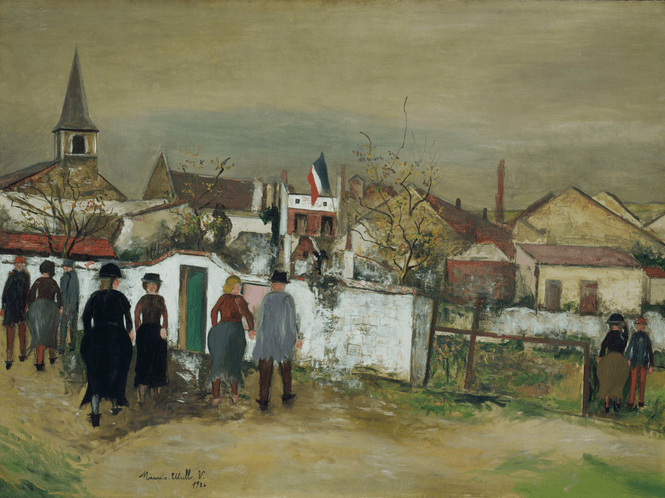
House at Vernon
This work, alongside Town Hall with Flag,
stands as one of the defining paintings of Maurice Utrillo's late style.
During this period, Utrillo worked with a far richer and more varied palette than before.
For this reason, the era is commonly referred to as his "polychrome period."
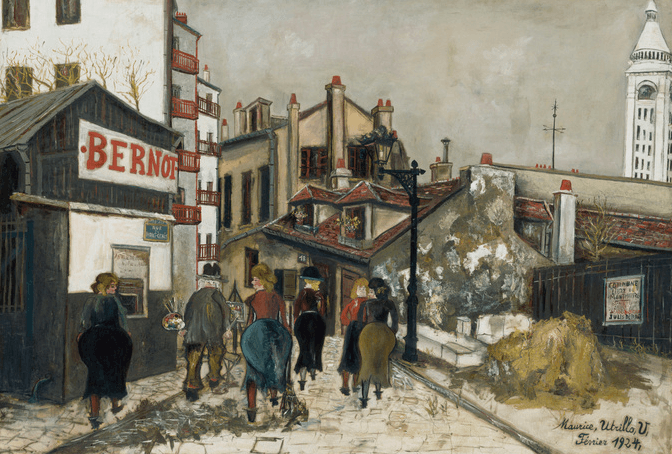
A Street at the Foot of Montmartre
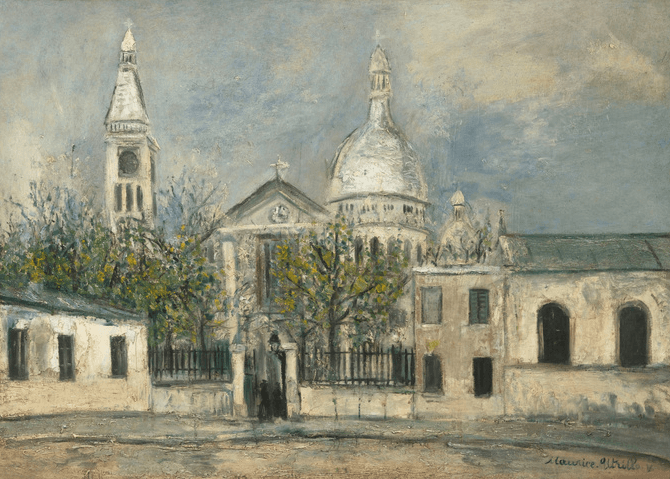
The setting of the painting is the Rue du Mont-Cenis, a street winding through the hill of Montmartre.
If you look closely at the upper right,
you can glimpse a portion of the Basilica of Sacré-Cœur, perched at the summit.
For anyone who has wandered through Montmartre in person,
the scene may carry a strange sense of familiarity.
The narrow lane,
the sloping hillside,
and the very air of an older Paris.
And Yet This Is Not a Painting Made Outdoors
What is fascinating is that
Utrillo did not paint this work on the street itself.
At the time, he was hospitalized for treatment of alcoholism.
Unable to venture outdoors, Utrillo worked from a postcard view of the Rue du Mont-Cenis,
completing the painting by calling upon his own memory of the place.
This picture, then, is not simply a landscape —
it is something closer to a landscape held inside the painter's memory.
The actual street and his recollection of it are woven together here.
The Rue du Mont-Cenis Today Looks Quite Different
This work was painted in 1924.
Visit Montmartre today, and you will find the neighborhood has changed considerably from what the canvas shows.
The Maison Bernot is gone,
and the character of the street has shifted in many ways.
And yet, curiously,
there are moments when the atmosphere of the painting seems to linger still.
Climbing the hill slowly,
one may suddenly find oneself imagining the Montmartre that Utrillo once gazed upon.
So if you ever find yourself walking the Rue du Mont-Cenis in Paris,
it may be worth pausing to recall this painting.
Perhaps what Utrillo was truly painting was not the street as it stood,
but the Montmartre he longed for.