Boy Bitten by a Lizard
Beauty leaves its mark in the most unguarded moment
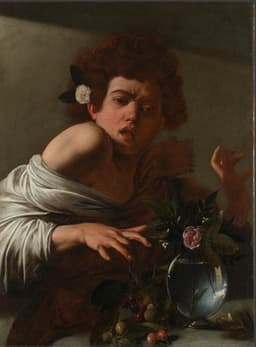
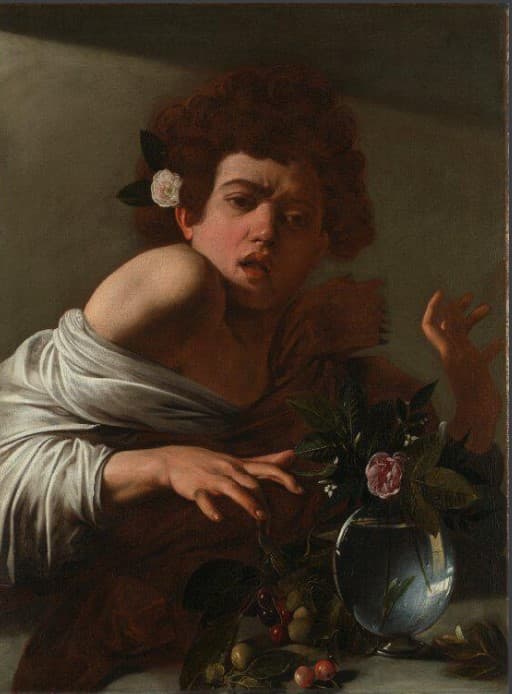
A beautiful boy reaches toward a potted plant on a table. Perhaps he had just been playing with the flowers a moment before — a single blossom tucked in his hair hints as much.
But in that very instant, a lizard lying in wait bites down on his finger.
A wave of shock crosses the boy's face, and in his hunched shoulders and instinctively curled fingers we feel the raw surprise of unexpected pain. It is less a frozen scene than the immediate witnessing of something that has just occurred.
Some see in this work a meditation on "pain concealed within beauty"; others read it as a painting of "the wounds that love leaves behind." The precise intent remains uncertain, but what is undeniable is that Caravaggio captured even the briefest flicker of emotion with astonishing fidelity to life.
The most dazzling element in the painting is the still life
The truly overwhelming moment in this work may belong not to the boy but to the objects arranged before him.
On the table lie ripe cherries and plums, while roses are placed in a glass vase. They feel fresh enough to release their fragrance at any moment, vivid enough to be touched.
Look closely at the vase in particular. On the transparent glass surface, the reflection of the room beyond is faintly but unmistakably visible. This goes far beyond "a well-painted still life" — it speaks to an almost obsessive attentiveness to light and space.
At the time, still-life painting was considered the lowest rung of the pictorial hierarchy. Yet Caravaggio made figures and objects breathe with equal intensity within a single canvas, and in doing so the still life ceased to be background and became the true subject of the painting.
A painter who followed what his eyes saw all the way to the end
This is precisely where Caravaggio diverged so sharply from his contemporaries.
Where many painters of the era worked from idealized beauty or images formed in the mind, Caravaggio observed the actual world relentlessly: the texture of human skin, the weight of fruit, the reflection in glass, the precise expression of a startled face. He sought to transfer the reality before him onto the canvas exactly as it was.
To us today it may seem an obvious approach, but in his time it was a genuinely strange and revolutionary act.
That is why Caravaggio's paintings still feel like living scenes, four hundred years on. As though even the instant the light grazed the surface has been held in place, unchanged.