Medusa
A Monster Seeing Its Own Face for the First Time
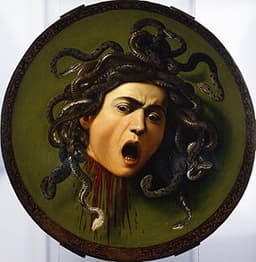
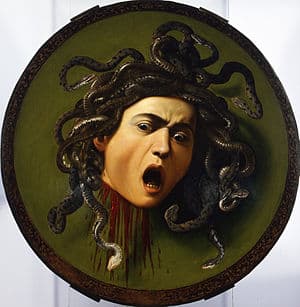
Medusa looks as though she has just caught sight of her own face.
Her eyes are wide with horror,
her mouth frozen open in a scream.
Blood spurts from her severed neck,
and the serpents atop her head writhe as though still alive.
Caravaggio has seized the most horrific of moments
and held it there, unrelenting.
A Moment More Terrifying Than Death Itself
Medusa was once a woman of remarkable beauty.
But after Athena's curse fell upon her,
her hair became a mass of serpents,
and anyone who met her gaze was turned to stone.
In the end, the hero Perseus struck off her head.
Most painters choose to emphasize the triumphant hero.
Caravaggio did not.
He places the dying face of Medusa squarely before us.
Why Did Caravaggio Paint This Expression?
Look closely.
Medusa's expression is not simple rage.
If anything, it is closer to terror.
Some have read this in a particular way:
"Could it be that in this very moment,
Medusa is seeing her own face for the first time?"
Perseus kills Medusa using a shield that reflects like a mirror.
In other words, at the very moment of her death, Medusa may have encountered her own reflection for the first time.
Caravaggio appears to have painted precisely that instant of shock.
Too Alive to Be Anything But Frightening
What makes this painting so unsettling is its excess of realism.
It is said that Caravaggio brought in live snakes to observe their writhing motion,
and studied his own face in a mirror to render Medusa's expression.
Light rakes sharply across the skin,
and the serpents' scales seem slick and alive.
He painted mythology,
but his method was pure, unmediated reality.
And So Caravaggio Becomes the Baroque
Caravaggio's paintings were never without controversy.
He painted saints as if they were people off the street,
and refused to idealize even the Madonna.
Yet it is precisely that sense of the real that makes people catch their breath before his canvases.
If the Renaissance dreamed of perfect beauty,
Caravaggio was a painter who looked unflinchingly at wounds and fear as well.
That is why people call him
'the beginning of the Baroque.'
And the Medusa may be
the face that announces that beginning most powerfully of all.