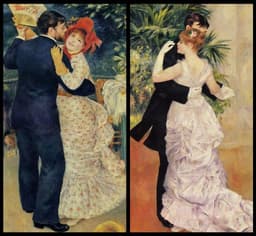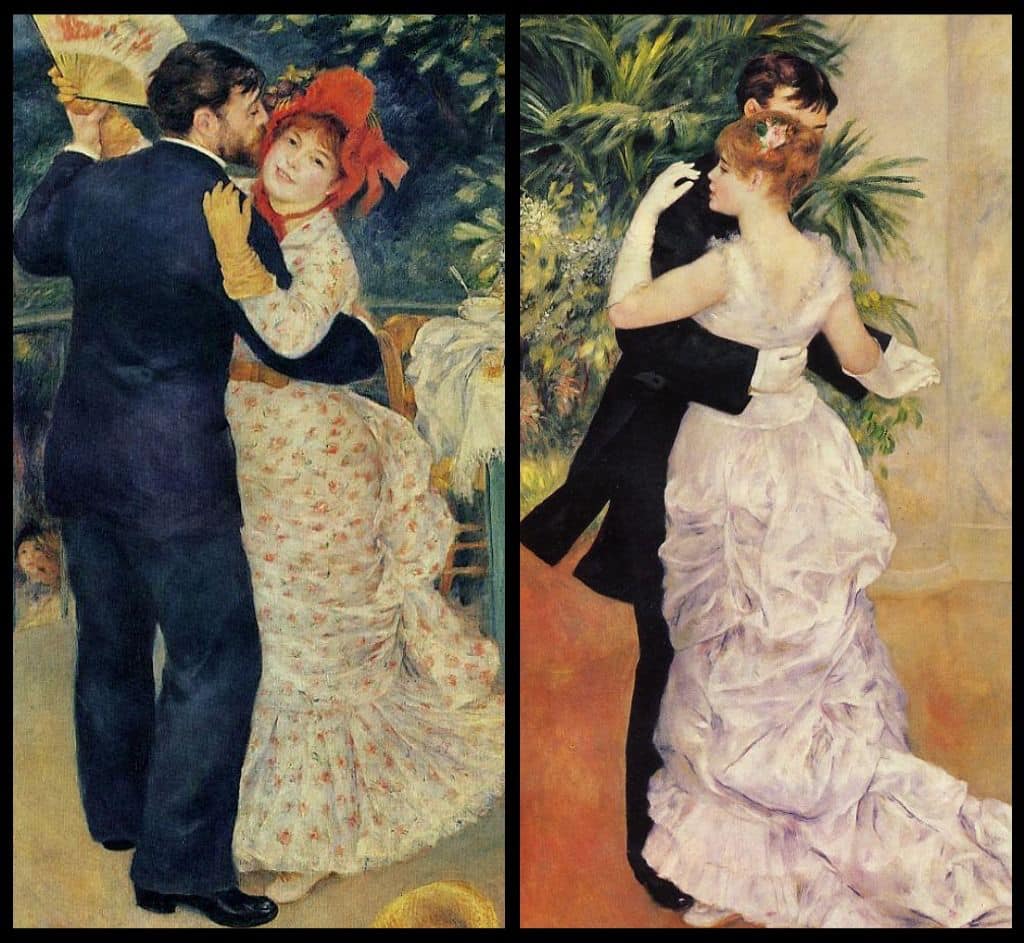
Dance in the City, Dance in the Country
The Same Dance, Two Entirely Different Moods
Both figures are dancing.
Yet one painting feels somehow cool and distant,
while the other is warm in a way that is almost surprising.
These are Renoir's Dance in the City and Dance in the Country.
Dance in the City Keeps You at Arm's Length
A woman in a white dress waltzes indoors.
Her partner is Lhote, a friend of Renoir's,
and the woman is Suzanne Valadon, a model much admired by painters of the day.
Look closely, though, and you will notice that her face is half turned away.
Her expression cannot quite be read.
Perhaps that is why a subtle sense of distance pervades the picture.
Elegant, certainly —
but possessed of an air that is not easily approached.
Dance in the Country, by Contrast, Is Far Warmer
The woman dancing outdoors holds a fan in her hand.
And there is laughter still lingering on her face.
She is Aline Charigot, the woman who would later become Renoir's wife.
At the time she was not yet twenty,
and the age gap between her and Renoir was considerable.
Yet by all accounts the two were deeply in love.
Is it any wonder, then?
Dance in the Country is a simple scene, yet it radiates an unmistakably human warmth.
A breeze,
body heat,
and an atmosphere in which laughter seems about to ring out at any moment.
Renoir Was Changing at This Point in His Life
These paintings were made in 1883.
By then, Renoir was already an established artist.
He had earned recognition at the Salon,
and among the Impressionists he had arrived at a stable, comfortable life relatively early.
And not long before,
he had returned from a journey to Italy.
There, Renoir had been profoundly struck by the work of Renaissance masters such as Raphael.
That transformation left its mark on these very paintings.
Between Impressionism and Classicism
The subject matter remains thoroughly Impressionist.
Ordinary people dancing,
a fleeting atmosphere caught and held.
But the manner of expression had shifted.
The outlines of the figures grew more defined,
and the brushwork became considerably smoother than before.
Rather than the shimmer of light,
it is the human form that asserts itself with greater clarity.
From this period onward, Renoir began to move away from being simply a painter of momentary light,
and toward a painter in pursuit of a more classical ideal of beauty.
The Impressionist Renoir and the Renoir who came after
seem almost to be passing each other
in these very canvases.