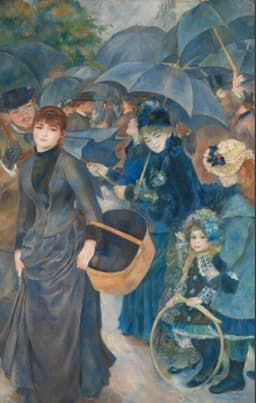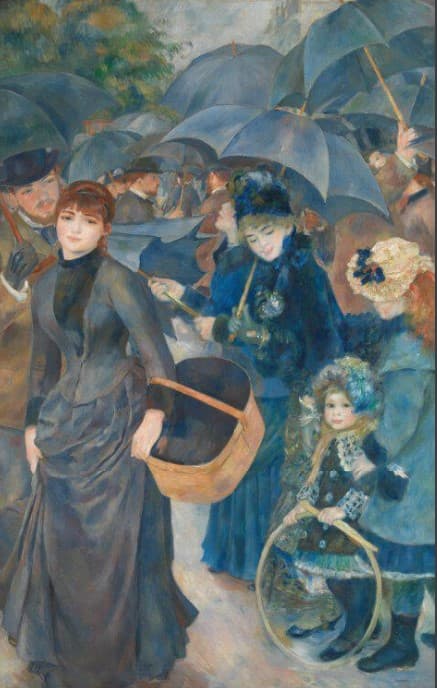
The Umbrellas
People carrying umbrellas fill the street.
It is Paris in the rain.
Figures brush past one another,
and black umbrellas ripple across the canvas like waves.
Yet the longer you look at this painting,
the more you sense a strangely different air around one particular figure.
It is the woman on the left.
She walks without an umbrella, entirely alone.
The One Who Stands Apart
Look closely at the woman on the left.
Her colors are slightly more subdued than those of the figures beside her, and her form is rendered with greater clarity.
The mother and child on the right, by contrast, are far softer and brighter.
The brushwork is lighter, with a quality that seems to dissolve into the air.
They belong to the same painting, yet the atmosphere is different.
There is a reason for this.
Renoir did not complete this work in a single sitting.
The Trace Left by Four Years
Renoir first began this painting in 1881.
At the time, he was working in a characteristic Impressionist style.
The umbrella-carrying woman on the right, the two children, and the woman behind them —
these four figures were all he painted at first.
That is why these figures are bright and soft.
Light seems to seep through them, and color dissolves like air.
Then Renoir set the canvas aside, leaving it unfinished.
Four years later, in 1885, he returned to it.
In the intervening years, his style had changed entirely.
From Impressionism toward a Sturdier Painting
The Renoir of 1885 was far more interested in classical methods than he had been before.
He wanted to render forms with greater definition,
and had come to regard the structure and contour of figures as paramount.
And so the woman and man added later on the left, along with their umbrellas,
appear far more linear and solid.
Their colors, too, are somewhat darker and weightier.
Within a single canvas,
the early Renoir and the transformed Renoir coexist at once.
The Umbrellas, then, is no mere street scene.
It is a painting in which the very moment of an artist's stylistic transformation has been preserved.
The Fashions of Paris Were Passing Through, Too
What is equally striking is that the passage of time is visible even in the fashion.
Look at the woman on the right.
A full velvet jacket and an elaborately decorated hat.
The style that was in vogue in Paris in 1881.
The woman on the left, by contrast, is far more restrained.
Her dress is spare, allowing the silhouette of her body to emerge.
Renoir may not have intended it,
yet this painting ended up documenting the shifting fashions of Paris as well.
A Moment of Change, Left Standing in a Rainy Street
Impressionist painters were always seeking to capture the "moment" —
light, weather, the movement of air.
The Umbrellas is something slightly different.
Held within this painting is not only the moment of a rainy afternoon,
but the time during which Renoir himself was changing.
And so it is not the umbrellas crowding the space between figures that linger longest in the memory,
but the figures themselves — each standing in a different moment in time.