Equestrian Portrait of Charles I
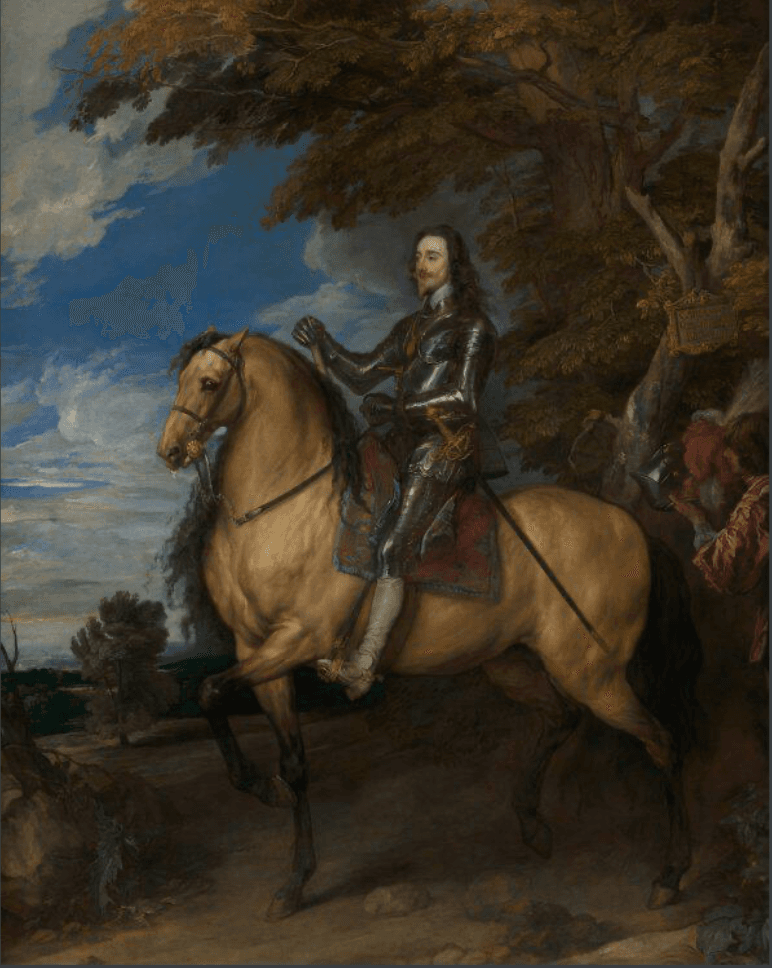
This is Van Dyck's Equestrian Portrait of Charles I.
Van Dyck was a Baroque master from Belgium who, in his youth, served as the chief assistant to Rubens. His exceptional talent and ambition soon became known across Europe, and it was not long before Charles I of England invited him to court.
Van Dyck went on to become the principal painter to the English royal household, leaving behind countless portraits of Charles I and the nobles and royals who surrounded him. This work is among the most celebrated paintings from that period.
Symbols of Royal Authority
Take a moment to look at the canvas.
Charles I sits astride an imposing horse, his bearing every bit as commanding as the animal beneath him.
The king is clothed in magnificent armor, over which he wears a gold collar. Look closely at the pendant, and you will find a scene of Saint George slaying the dragon — an emblem of the Order of the Garter, the highest order of chivalry reserved exclusively for the sovereign.
Notice, too, the baton held in his right hand. This is the marshal's staff carried by the supreme commander of the army.
And on the stone pillar behind the king, a Latin inscription reads "Charles, King of Great Britain," carved in stone for posterity.
Through each of these carefully chosen details, Van Dyck underscores the fact that Charles I was a monarch of absolute power.
More Majestic Than Life
What makes this portrait all the more intriguing is the reality of Charles I's physical appearance.
He stood roughly 164 centimeters tall — a slight figure, even by the standards of his day. Yet in this painting he appears considerably larger and more commanding than he ever was in life.
The equestrian portrait — a painting of a ruler on horseback — was a format long favored for projecting the power and authority of kings and generals. Van Dyck exploited composition and viewpoint to render Charles I as a monarch of far greater grandeur than his actual stature would suggest.
The King's Final Act
Yet the fate of the proud king depicted here would not endure.
Charles I levied taxes without parliamentary consent and pressed his religious policies with unrelenting force, provoking fierce resistance among his subjects. Defeated in the English Civil War, he was put on trial and executed on the scaffold.
He is recorded in English history as the first monarch to be tried and executed by the judgment of his own people.
Knowing this, and looking at the painting again, the kingly majesty that once symbolized absolute power takes on a profound and unsettling irony.
The Finest Court Painter in Europe
Van Dyck reached the peak of his career during his years as a court painter.
The elegant and refined portraits he produced set a new standard for aristocratic portraiture across Europe, leaving a particularly enduring mark on the art of Britain.
The work before you is far more than a royal likeness. It is perhaps the most perfect expression of the authority a king wished to project to the world — a vision of the ideal sovereign rendered in paint.