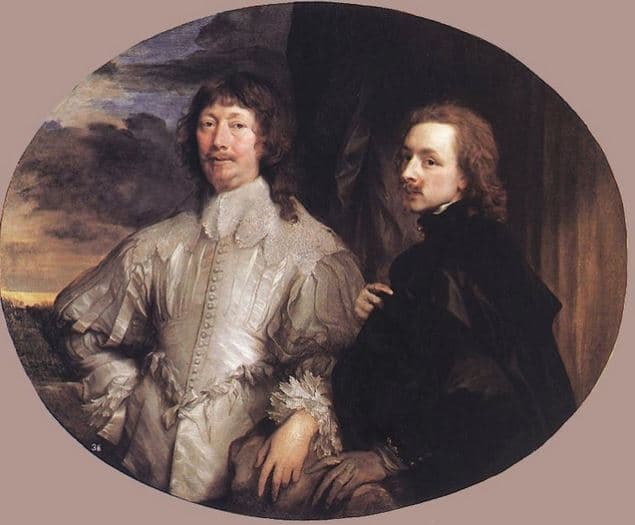
Self-Portrait with Sir Endymion Porter
What is the relationship between these two men?
There is something unmistakably elegant and refined about this work. As you can see, it is a double portrait — two figures sharing the same canvas. But who exactly are these two men, and what bound them to each other?
The figure on the right, dressed in black, is none other than the artist who painted this work: Van Dyck himself. The nobleman on the left, resplendent in ornate white, is Sir Endymion Porter — Van Dyck's patron and close friend.
Meeting a lifelong patron
Sir Endymion Porter served as a diplomat at the English court, and his eye for art was exceptionally sharp — he recognized Van Dyck's talent before almost anyone else. He went on to become the painter's most important patron during Van Dyck's years in England, offering generous and unwavering support throughout.
It was in gratitude for that support that Van Dyck painted this portrait.
A thoughtfulness hidden within the painting
Let us now look a little more closely at the picture.
First, compare the heights of the two figures. Look carefully, and you will notice that Van Dyck has painted himself ever so slightly shorter than Sir Endymion Porter. The difference is subtle enough to pass unnoticed at a glance — yet it is entirely deliberate. It reflects Van Dyck's quiet deference to his patron, a gesture of respect for Porter's elevated social standing.
There is another detail worth noting. Look at the left hands of both men. Do you see how they rest them side by side on a rock?
That rock is a symbol: the bond between the two men is as solid and enduring as stone. It speaks of something beyond the conventional relationship of patron and painter — a singular friendship grounded in mutual trust and respect.
Could a painter stand alongside a nobleman?
There is yet another intriguing aspect to consider: the fact that Van Dyck chose to include himself in the portrait at all.
This is generally read as a statement — that an artist was no longer merely a craftsman who made pictures, but a figure capable of standing as an equal among the nobility. In other words, the work encapsulates a broader cultural shift: the rising social status of art and artists in the seventeenth century.
The finest portrait painter in Europe
Van Dyck was Netherlandish by birth, and together with Rubens he stands as one of the defining figures of Baroque painting. In portraiture in particular, he enjoyed a reputation unmatched anywhere in Europe. As official painter to the English royal court, he produced an extraordinary number of portraits of kings and aristocrats, and his graceful, polished style proved so influential that it effectively set the standard for English portrait painting for generations to come.
The work before you is not simply a record of two men's appearances. It is a painting that holds within it the singular relationship between a patron and an artist who held one another in genuine esteem — and the spirit of an age in which the standing of the artist in society was quietly, steadily rising.
Look once more at the expressions on their faces, and at the hands resting together on the rock. The painting, you may find, now speaks far more than it did at first glance.