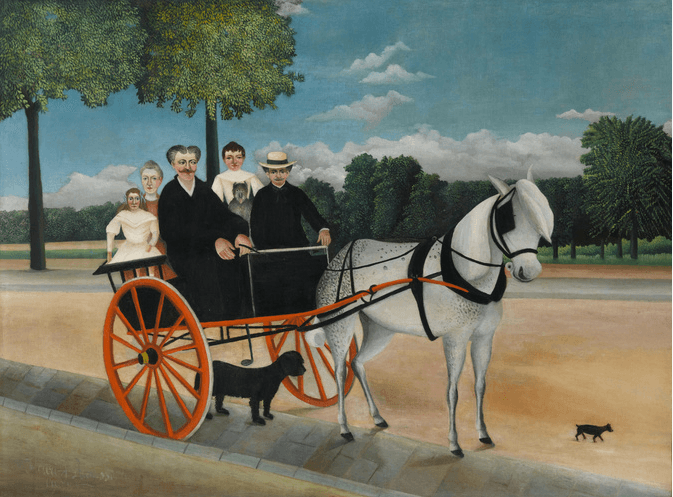
The Cart of Père Junier
He gave a painting as a gift to the grocer
There is a peculiar warmth to this painting.
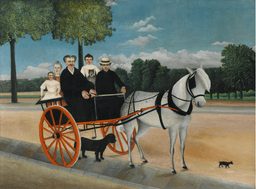
A family setting off somewhere by carriage, dogs scampering about, and the expressions of people dressed in their finest.
It feels rather like pulling out an old family photograph.
And in fact, it truly did begin with a photograph.
The painting's subject, Monsieur Juniet, was the owner of a grocery shop that Rousseau frequented.
The two were quite close.
Juniet would extend Rousseau credit for food, and they occasionally shared meals together.
Rousseau's circumstances at the time were far from comfortable.
He had chosen the path of a painter, but life was always a tight affair.
Rousseau therefore felt embarrassed at always being on the receiving end of kindness.
Then one day, upon seeing a photograph of the Juniet family boarding a carriage for an outing to the countryside, he decided to immortalize that moment in paint.
Traced from a photograph, yet strangely dreamlike
It is fascinating to compare the photograph and the painting side by side.
The painting clearly draws on the actual photograph, and yet it reads like a world slightly removed from reality.
The overall composition is, of course, similar.
But once Rousseau's distinctive style is layered over it, the entire scene becomes strangely surreal.
What is particularly intriguing is that figures absent from the photograph have been added.
Rousseau included Juniet's niece and grandniece within the composition.
This work, then, is less a straightforward record than a reconstructed scene — one that captures the family atmosphere Rousseau wished to preserve.
Why are all the figures looking directly at us?
Look closely at the figures now.
With the exception of Monsieur Juniet, who is turned slightly to one side, nearly every figure stares straight out at the viewer.
Much like the figures in ancient Egyptian wall paintings or stone reliefs.
And so, despite depicting an everyday scene, the painting feels as though it exists outside of time.
The scale of the figures, too, is handled with remarkable freedom.
In medieval painting, important figures were often rendered larger, and lesser figures smaller — and Rousseau employs proportion in much the same arbitrary way.
What mattered to Rousseau, in other words, was not the accurate transcription of reality.
What mattered far more was the feeling and presence that a scene conveyed.
Rousseau's dogs are stranger than reality
The most captivating element of this painting is, in truth, not the people but the dogs.
Look at the small dog held by the niece.
Its head is rendered in a manner that is somehow goblin-like.
At the time, it was fashionable to adorn dogs' ears with pins, and Rousseau has depicted this with a delightfully playful touch.
And the dog beneath the carriage is implausibly large.
The small dog in front of the horse, by contrast, has been painted so tiny it could scarcely exist in the real world.
Scale has been thrown into complete disarray.
And yet, strangely, this very awkwardness only makes the painting more compelling.
It feels like the landscape inside a child's imagination.
Why does the horse appear to be floating in mid-air?
Now look carefully at the horse.
Its hooves are ever so slightly lifted.
As though it is standing on tiptoe.
The horse thus gives the impression not of standing on the ground, but of hovering gently above it.
And it is precisely this sensation that lies at the heart of Rousseau's painting.
Every figure in his paintings seems to be saying something.
"I am not real."
And yet, at the same time, neither are they entirely fantasy.
Somewhere between reality and dream.
Rousseau always erected his paintings upon that ambiguous boundary.
And so his work, though often called clumsy, ultimately won the hearts of many.
There were many painters who rendered the world with precision, but few who looked upon it with such purity and strangeness as he did.