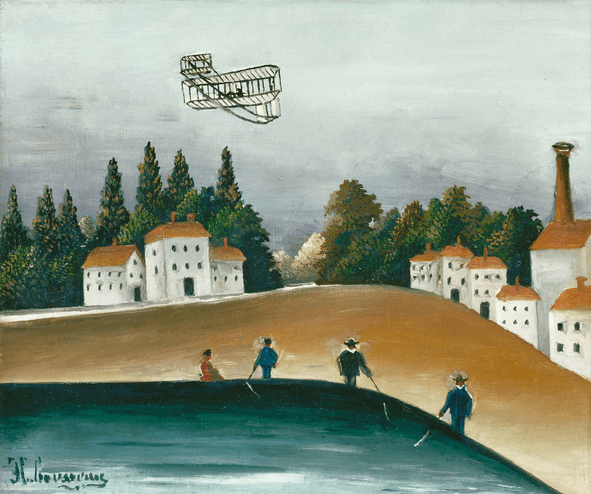
The Fishermen
Rousseau Was Not Born a Painter
Henri Rousseau was, by trade, a customs officer.
Which is why people called him "le Douanier" — the customs man.
What makes this so striking is that Rousseau had almost no time to paint.
He was required to work every weekday without exception.
In today's terms, he held a day job and squeezed painting into his weekends — a life lived in two shifts.
So Rousseau painted mainly on Sundays.
Yet the customs service, in those days, was hardly the secure and comfortable post it might sound today.
The pay was meager, and the workload was punishing.
At some point, Rousseau arrived at a thought he could no longer ignore.
'If I'm barely earning anything either way, I might as well do what I love.'
And so he set down his steady livelihood and, late in life, stepped onto the path of a full-time painter.
In hindsight, it was a wildly reckless decision.
Yet it was also the kind of decision only someone with a true and abiding passion could make.
With Time Finally His Own, He Went to the River
This painting belongs to that later period — made after Rousseau had taken up painting as his principal calling.
Once he left his post, he found himself with far more time than he had ever known.
And so he went fishing — one of his oldest and most cherished pastimes.
Then he painted what he saw.
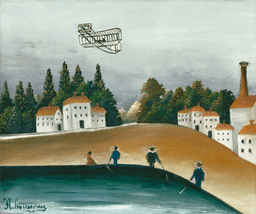
The riverbank in the painting is uncannily still.
The water lies flat and glassy; figures sit at leisure, lines cast into the current.
At first glance, it reads as an unremarkable landscape.
But as with all of Rousseau's work, the longer you look, the more something quietly begins to feel strange.
The True Subject of This Painting Is in the Sky
The painting is titled The Fishermen.
So at first, the anglers along the bank seem to be the protagonists.
But look slightly higher.
A small aircraft floats in the sky.
What Rousseau truly wanted to paint may well have been that airplane.
This was the era when humanity first began to fly.
The Wright Brothers — those names we all learned in school — were at that very moment building the machines that made it possible.
The aircraft in the painting is modeled on an early design by Wilbur Wright.
A deeply primitive form — no wheels, nothing yet refined.
Simple as it looks to us today, the airplane was, to the people of that age, something close to a shock — a rupture in the ordinary.
A human being, actually flying through the sky.
It was the kind of experience that rearranges the entire order of the world — not unlike the moment our own generation first encountered AI or the smartphone.
Painters of the time frequently placed airplanes in their compositions, treating them as emblems of a new age.
Rousseau, too, was powerfully drawn to that transformation.
A Naïve Eye Sometimes Captures an Era Most Precisely
Rousseau's paintings have often been called clumsy.
His perspective is imperfect, his figures sit awkwardly, and his landscapes depart from reality in ways that are hard to ignore.
Yet it is precisely that ingenuousness that makes his paintings linger in the memory.
There is a quality of wonder in them — the gaze of a child encountering the world for the first time, marveling at new civilizations and new landscapes simply as they are.
So this is not simply a scene of fishing.
It is closer to a moment when a new age of humanity drifts slowly overhead, while people at the water's edge enjoy an unhurried afternoon.
Perhaps Rousseau was recording something profoundly important — without quite knowing it himself.
Above an ordinary Sunday sky, the world was on the verge of changing forever.