Lola de Valence
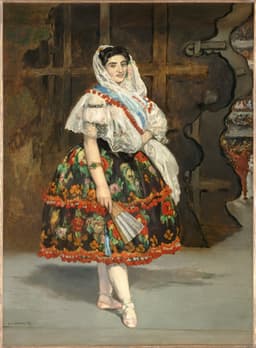
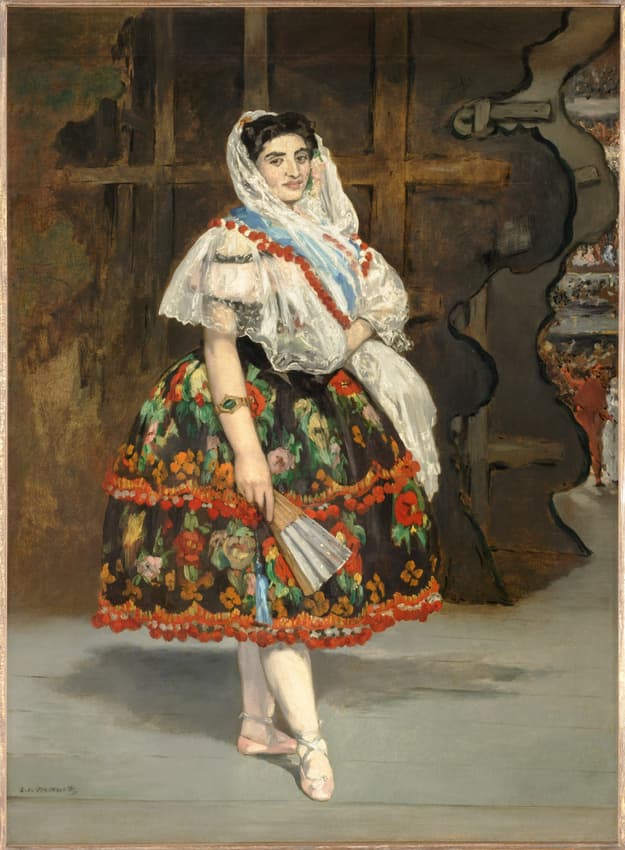
The Spanish dancer Lola de Valence stands facing us, dressed in a splendid costume.
Her expression,
her posture — both are strikingly self-assured.
She seems to say, "This stage belongs to me."
This work is one of Manet's most representative paintings in the so-called "Spanish manner," created after he became deeply captivated by Spanish art.
Black, Red, and Luminous Skin
What strikes the eye first is the intensity of the color contrasts.
A deep black background,
red ribbons adorning the dress,
and shoulders and arms that seem to radiate light.
As the colors clash forcefully against one another,
the figure emerges with even greater clarity.
This dramatic treatment reflects the influence of Velázquez and Goya, both painters whom Manet deeply admired.
One can feel their legacy especially in the way the background is kept spare and empty,
thrusting the figure boldly toward the viewer.
What Mattered More Than the Dance
Paintings of dancers typically emphasize movement and gesture.
But Manet had no interest in simply depicting a moment of dance.
He painted Lola de Valence not as
a figure to be gazed upon,
but as a person standing before us with full dignity.
This is why the painting feels less like a scene from a performance
and more like a portrait that reveals the sheer presence of a single individual.
It is precisely this quality of vision that makes Manet so remarkably modern a painter.
"She Is Like a Line of Poetry"
The work caused considerable excitement when it was shown at the Salon of its day.
The poet Charles Baudelaire, upon seeing it, is said to have remarked:
"She is like a line of poetry."
The deep black,
the gaze directed straight at us,
the fierce interplay of color.
Within all of these elements lies the restless inquiry of a painter
who never stopped experimenting with how a figure might be seen anew.
And so Lola de Valence feels like more than a dancer —
she feels like the arrival of an entirely new kind of figure in modern painting.