Wheat Field with Cypresses
Into a Summer Landscape
This work was painted during the period when Van Gogh was staying at the psychiatric hospital in Saint-Rémy, in the south of France.
Let us begin by taking in the painting as a whole.
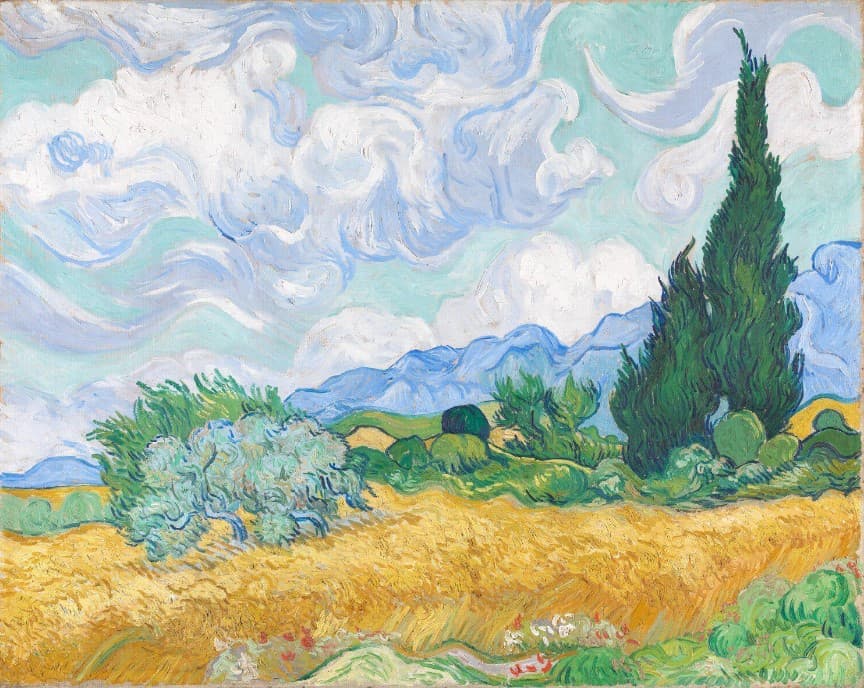
A golden wheat field on the verge of harvest stretches across the foreground, giving way to olive trees, rolling hills, and the Alpilles mountain range beyond. Long ribbons of blue cloud drift across the sky, while red poppies bloom along the lower edge of the canvas.
It appears, at first glance, to be a scene of tranquility — yet look more closely, and you sense that the entire painting is in perpetual motion.
Painting the Wind
The wheat field bends as if swept by a single gust, and the clouds spiral and surge overhead.
The olive trees twist and sway in sinuous curves, while the cypress rising at the center trembles like a tongue of flame.
Van Gogh was profoundly struck by the fierce winds that swept through Saint-Rémy during his time there.
And so he rendered the invisible wind through the very movement of his brushstrokes.
Those swirling marks are not mere decoration — they are a direct transcription of the energy with which nature moves.
The Most Commanding Tree
Now turn your attention to the great cypress standing at the center of the composition.
The fields and mountains all extend horizontally across the canvas, yet the cypress alone surges upward, reaching straight toward the sky.
In a letter to his brother Theo, Van Gogh described this tree as "a dark presence within a luminous landscape."
To him, the cypress was far more than a tree.
Its ceaselessly agitated, flame-like form seemed to mirror his own inner state — one of restlessness and anguish.
A State of Mind Hidden in Nature
Van Gogh was never a painter who simply recorded the landscape before him.
The nature he perceived moved in concert with his own emotions.
And so this painting holds within it not only the wind sweeping across a summer field, but also the inner world of the man who stood there watching it.