Self-Portrait
The First Painter to Fall in Love with the Selfie
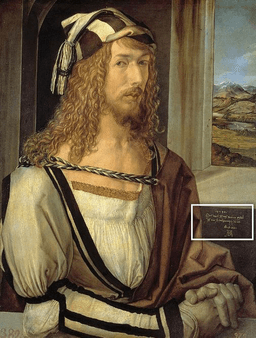
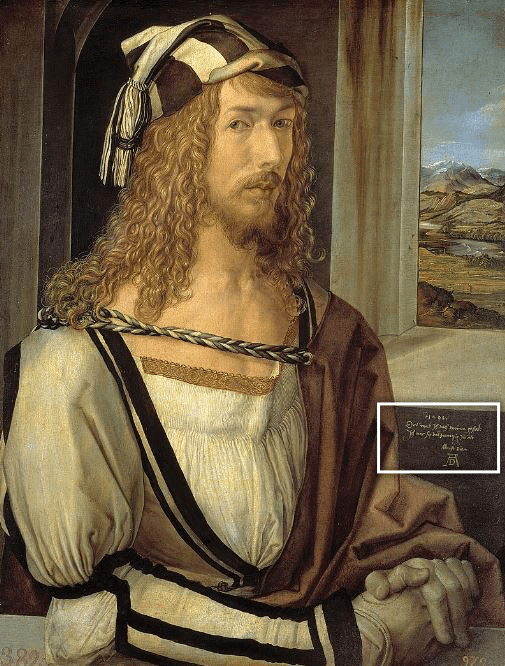
A man gazes straight ahead.
Long hair, impeccably groomed.
Expensive clothes.
And a pair of pristine white leather gloves.
Honestly, at first glance he looks less like a painter and more like a nobleman.
What is astonishing is that this man painted himself this way.
This is Albrecht Dürer at twenty-six.
Why Did Dürer Paint Himself So Magnificently?
At the time, a painter's place in society was nothing like it is today.
We call painters "artists" now,
but in that era most painters were closer to craftsmen who produced works on commission.
Yet as the Renaissance took hold, that perception began to shift.
Painters were no longer seen merely as people with nimble hands;
they were beginning to be recognized as beings possessed of intellect and creative vision.
And Dürer was quicker than anyone to read that change.
So he did not paint himself as an ordinary painter.
He wanted to look like a nobleman.
Look closely.
The texture of the fabric is rendered with almost excessive precision,
and each strand of hair seems to catch the light individually.
And then there are the white leather gloves.
In that era, such gloves were a symbol of wealth and refinement.
This painting, then, is not simply a self-portrait —
it is closer to a declaration: "I am no mere craftsman."
Dürer's Answer, Hidden in the Painting
You might find yourself wondering.
"How can we really know that Dürer painted this with that intention?"
As it happens, Dürer left the answer directly within the painting.
Look carefully beneath the window on the right.
There is an inscription in white lettering.
At the top, the year the work was made: 1498.
And below that, these words:
"I, Albrecht Dürer, painted this of myself from my own point of view."
It is a remarkably striking sentence.
It is not simply a record of his own face.
It reads more like a declaration: "This is how I see myself."
And in that gaze, Dürer is not a humble artisan —
he is an elegant, dignified Renaissance man.
The Alps Beyond the Window Are His Ambition
The background beyond the window is no casual landscape either.
The mountains visible there are the Alps.
Dürer had traveled from Germany to Italy to immerse himself in the Renaissance,
and that journey required him to cross the Alps.
Those vistas must have left a vivid and lasting impression on him.
And so he placed those mountains behind himself in his own self-portrait.
As if to say:
"I am someone who has seen a wider world and returned."
What is fascinating is that two worlds coexist within this single painting.
The sense of spatial depth and the treatment of the landscape echo the Italian Renaissance style,
while the painstaking detail of the hair and the folds of clothing is distinctly Northern European in manner.
This painting is the face of one man, Dürer, and at the same time
a scene in which the Renaissance of the South and the tradition of the North converge.
The First Painter to Fall in Love with the Selfie
Dürer left behind a remarkable number of self-portraits.
He is said to have painted his first self-portrait at the age of thirteen —
before he had received any formal training.
That young boy sat before a mirror and drew his own face.
And remarkably, it was already accomplished beyond his years.
This is also why Dürer's self-portraits hold such a singular place in art history.
There had been almost no painter who placed himself so boldly at the center of his own work.
Of course, the precise reasons why he painted so many self-portraits remain unknown.
But one thing seems clear.
Dürer was someone who found himself genuinely fascinating.
Perhaps he already understood, five hundred years ago,
that a person is ultimately remembered according to how they choose to see themselves.