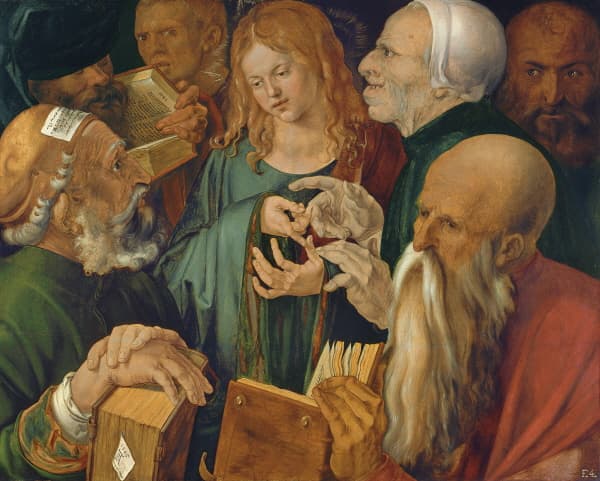
Christ Among the Doctors
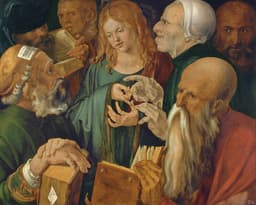
The boy counts on his fingers and speaks in a quiet, steady voice.
Yet the faces of the adults around him betray a certain unease.
One looks startled,
another disapproving,
and another turns to regard Jesus with an expression of bewilderment.
This is Albrecht Dürer's Christ Among the Doctors.
As the biblical episode recounts, the young Jesus engages a gathering of scholars in debate.
He was, by that account, only twelve years old.
Look at the faces, and the painting's intention becomes clear
The face of Jesus at the center is strikingly luminous and composed.
The faces of the scholars around him, by contrast, are creased and contorted to an almost exaggerated degree.
Look closely at the figure on the right wearing the white cap.
He verges on caricature.
Dürer constructed this contrast deliberately.
Youth against age.
Innocence against appetite.
And genuine wisdom set against the hollow performance of authority.
The moment the Renaissance met the Northern tradition
This work was painted during the period when Dürer was residing in Venice.
The pictorial composition is therefore balanced and harmonious in the Renaissance manner,
while the rendering of faces is sharply observed and unflinchingly real — the mark of a Northern painter.
Pay particular attention to the hands.
Each finger seems to pulse with life.
The gesture of Jesus counting on his fingers was, in fact, a recognized pose from theological disputation of the period.
"Completed in five days"
On the sheet of paper at the bottom of the painting, alongside Dürer's signature, an inscription reads:
"Completed in five days."
A statement of remarkable confidence.
Yet the longer one spends with the painting,
the clearer it becomes that what is truly astonishing is not the speed, but the acuity of his eye for the human face.
Dürer may not have been illustrating a biblical story at all.
He may have been painting the desire and anxiety that lie hidden in the expressions of men.