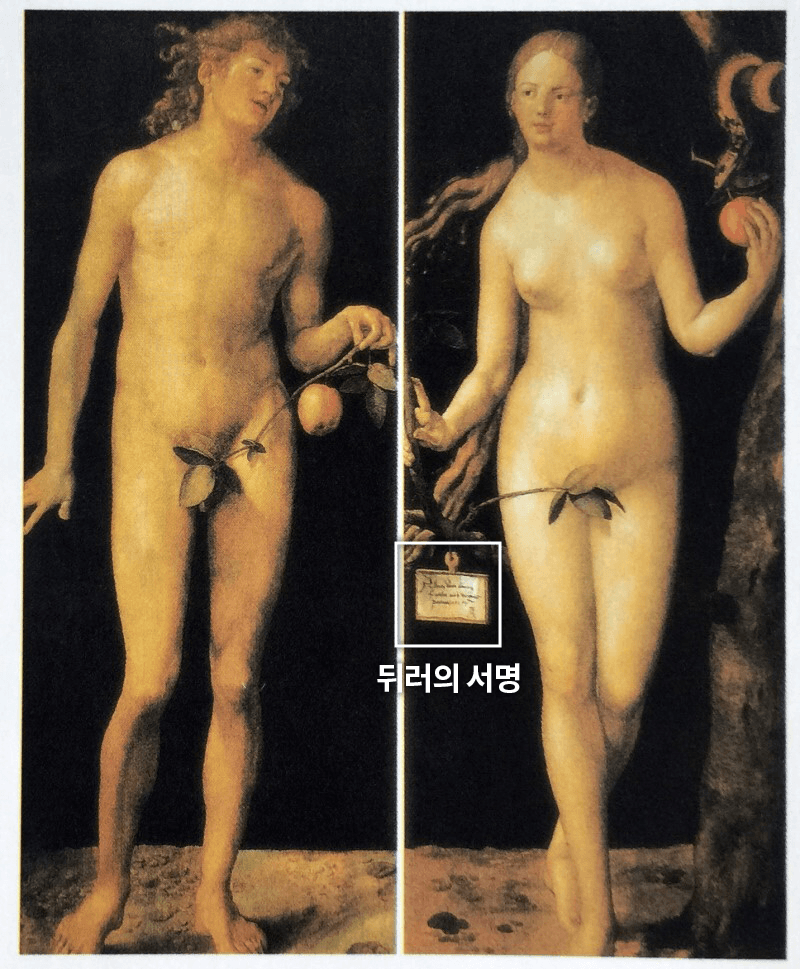
Adam and Eve
Why does forbidden beauty tempt us first?
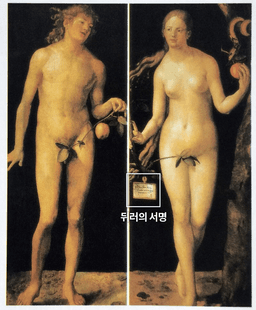
The two figures have not yet concealed their bodies.
Their expressions suggest they already know.
Albrecht Dürer's Adam and Eve is not simply a biblical painting.
It is closer to the moment when human desire first reveals itself.
A Renaissance outsider born in Germany
Dürer was from Nuremberg, Germany.
Yet culturally, the atmosphere of the Middle Ages still held firm.
Italy, by contrast, was an entirely different world.
At the heart of the Renaissance, where Leonardo da Vinci and Michelangelo were at work, the human body itself had become art.
Dürer ultimately set out for Italy — the first journey of its kind in the history of German art — to see this new world for himself.
He absorbed the Renaissance there and carried it back to Germany.
This painting, then, is no simple nude.
It can be read as the very moment the Renaissance first seeped into medieval Germany.
Dürer didn't paint the body — he calculated it
He was obsessed with the human body throughout his life.
How long must the arms and legs be to achieve perfection?
Almost like a scientist.
After countless figure drawings and studies, Dürer at last completed a life-size nude.
That work is Adam and Eve.
But what matters here is not simply the nakedness.
In the early Renaissance, the nude itself was taboo — condemned as obscene.
So painters who wished to depict the nude were obliged to invoke a "religious justification."
And the most perfect pretext for that was Adam and Eve.
The first humans who wore no clothes.
Painters were, in effect, borrowing scripture to paint the human body.
An emotion that arrives before guilt
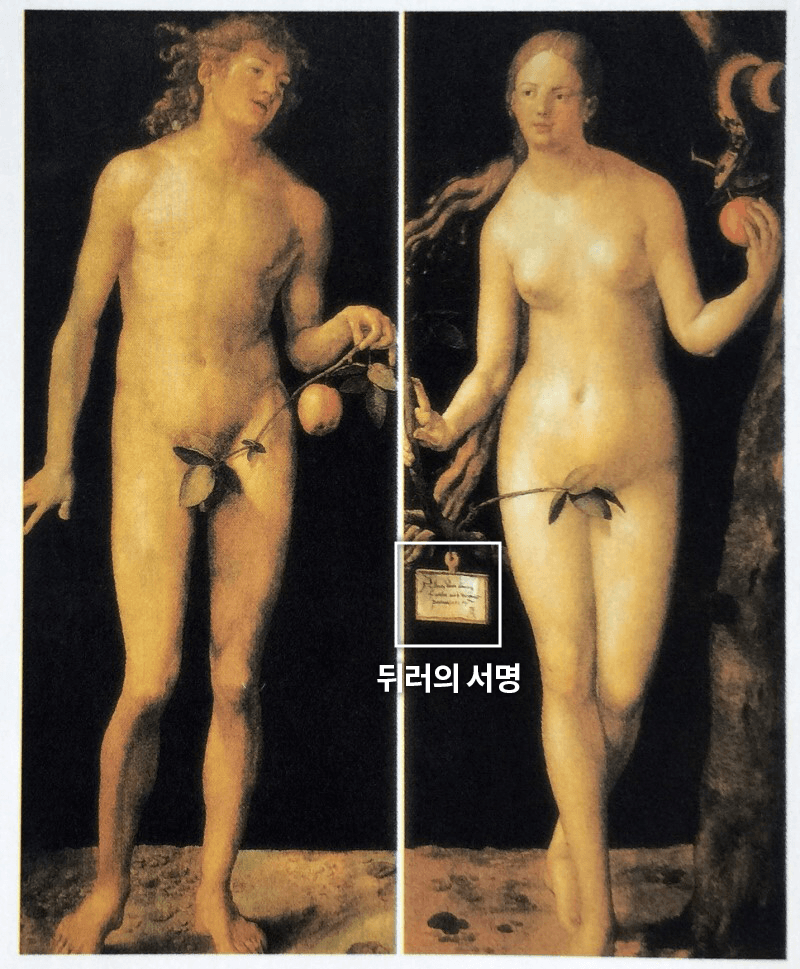
And yet a strange tension and beauty pervades the entire canvas.
As if Dürer were saying: "Human desire is a sin, and at the same time the most human of instincts."
That is why this painting is a religious work and yet profoundly worldly.
It does not depict humanity through the story of God.
It borrows the story of God in order to lay bare human desire.
The hidden signature within the painting
What is forbidden is long remembered
This work was once part of the collection of a Swedish queen before being given as a gift to Philip V of Spain, eventually finding its home at the Museo del Prado.
Centuries on, people still linger before this painting.
Perhaps human beings have long understood something.
That the most dangerous temptation always wears the most beautiful face.