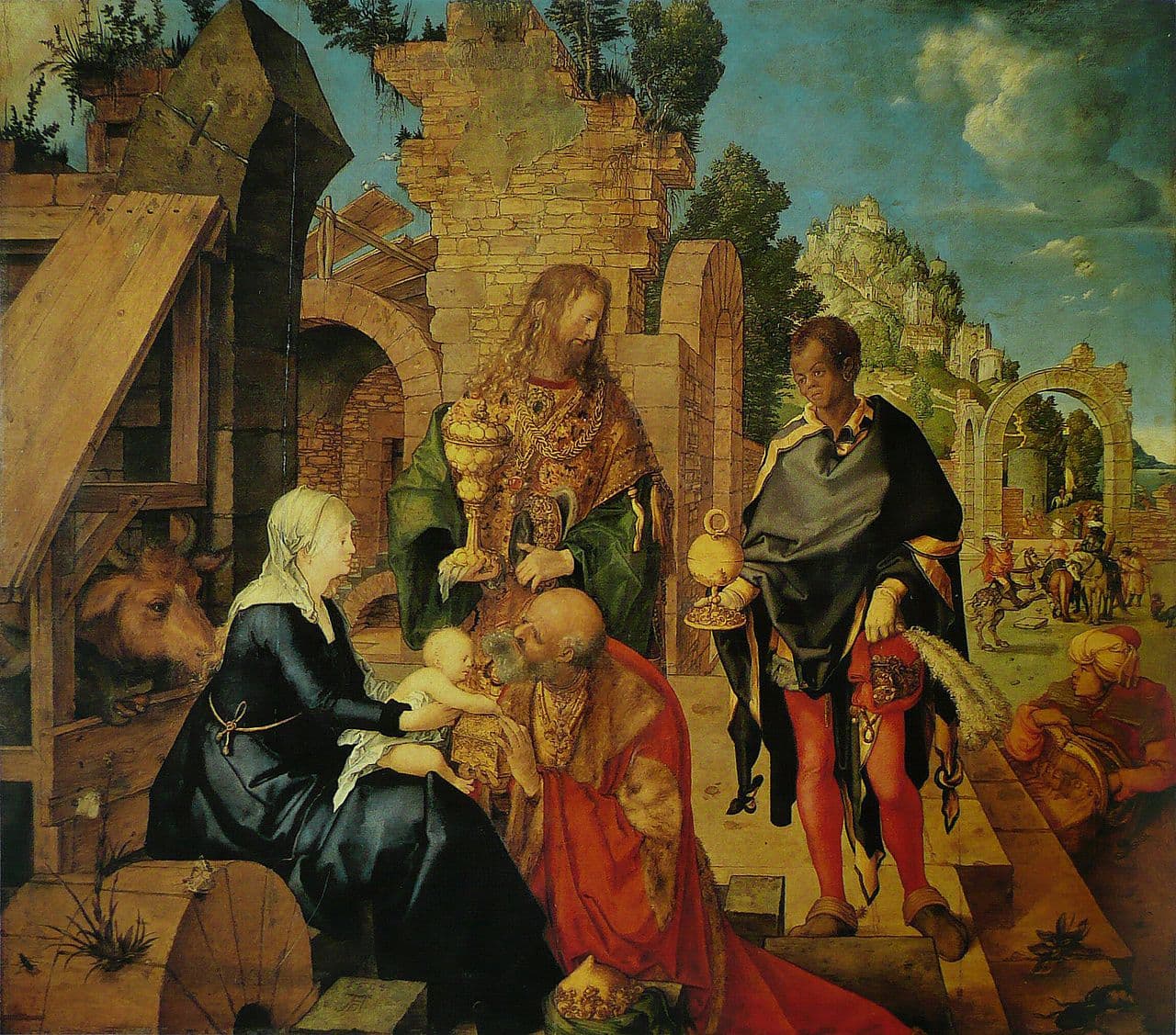
동방박사의 경배
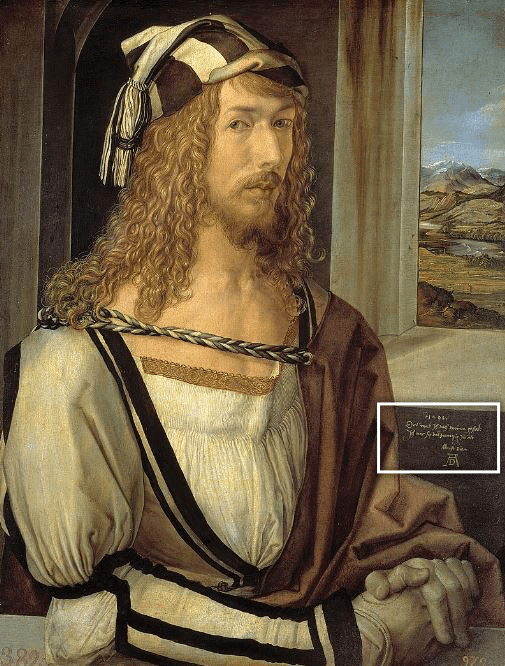
At the center of the painting stands a man with long hair.
Magnificent clothing.
Jeweled adornments.
And an expression that radiates unmistakable self-assurance.
At first glance, he might be taken for one of the Magi —
but in fact, he is the very painter who made this work.
Albrecht Dürer himself.
When a German Painter Encounters Italy
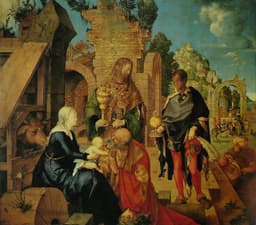
This work is Dürer's Adoration of the Magi, painted after his return from his first journey to Italy.
And so the painting blends the Northern European tradition with the Italian Renaissance in a way that feels entirely natural.
The massive rocky mountain in the background recalls Andrea Mantegna, the painter from Padua,
while the luminous, crisp palette reflects the influence of Venetian painters such as Giovanni Bellini.
Take particular note of the ruined arch visible in the distance.
Renaissance painters frequently depicted crumbling Roman architecture,
a symbol signifying that "with the birth of Christ, the old pagan world had come to an end."
As a result, this painting feels less like a Northern European work and more like an Italian Renaissance canvas at first sight.
The Closer You Look, the More Dürer It Becomes
Yet draw closer, and the meticulous detail characteristic of a Northern European master comes alive.
The stag beetle on the steps in the lower right alludes to the sacrifice of Christ,
while an old millstone beside the Virgin is painted with an ant and a butterfly.
Symbols of life and resurrection.
And on a small stone beneath the Virgin's feet, the date 1504 and Dürer's monogram A.D. are inscribed.
Dürer was a painter who filled even the smallest corners of his work with symbolic meaning.
In the End, the Most Splendid Figure in the Painting
What remains most striking is, of course, Dürer's own likeness.
He is dressed far more magnificently than any of the other Magi.
His jewelry and precious ornaments are conspicuously abundant.
Dürer was, in fact, well known as a man who took great pleasure in fine clothing and deliberate self-presentation.
And he would go on to become more than a mere painter —
extending his reach into printmaking and art theory, he became one of the first truly international artists to make his name known across all of Europe.
Perhaps Dürer already understood something.
That painting well was not enough on its own —
leaving oneself behind as a kind of brand was just as important.