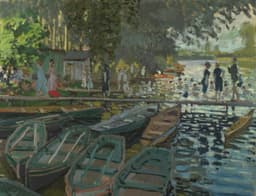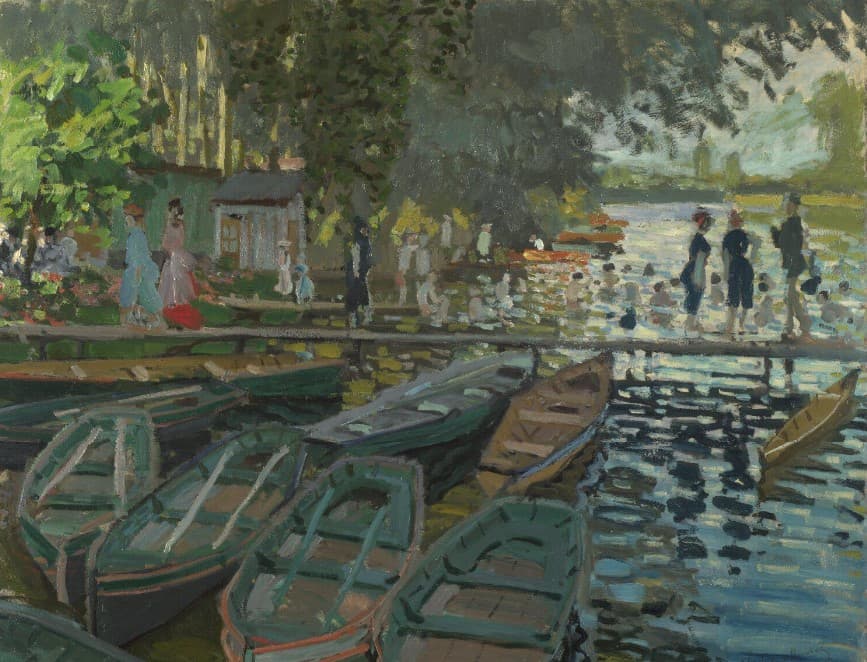
Bathers at La Grenouillère
On weekends, Parisians escaped to the riverbank
For the people of Paris in the 1860s, the weekend was a chance to step away from the city for a little while.
They gathered at leisure spots along the Seine, spending their days swimming in the sunlight, rowing boats, and drinking.
And one of the most celebrated of these destinations was La Grenouillère.
By today's standards, it was the go-to weekend hotspot for Parisians.
Monet looked out at that scene and set about capturing the afternoon air of a crowd at rest inside his painting.
This painting was never meant to be finished
Look closely at the painting.
The brushwork is strikingly fast.
Rather than refining forms with precision, short and light touches sweep across the surface.
It looks almost like someone desperately trying to seize the light before it disappears.
That is because this painting was never intended to be a finished work in the first place.
Monet was rapidly sketching the scene so that he could later return to his studio and paint a fully realized version on a larger canvas.
What we are looking at, then, is the briefest of moments — a master pinning down the scene before his eyes.
Regrettably, the large finished work he produced from this sketch has since been lost and no longer survives.
And so, paradoxically, this small sketch feels all the more precious.
It has the feeling of a starting point for a great masterpiece.
The light was already complete
Now look at the center of the painting. There is a narrow bridge stretching across it from side to side.
And remarkably, that bridge serves as a dividing line — the mood of the picture shifts entirely on either side of it.
Above the bridge, the scene glows brightly in the sunlight; below it, shade falls and everything becomes cooler and darker.
Monet would later become known as the painter of light.
And that gift is already unmistakably visible in this small sketch.
Look carefully at the surface of the water beneath the bridge.
On the blue water, the reflection of green leaves trembles and ripples.
Monet was not simply painting water — he was painting how light fractures and dissolves across its surface.
That is why, when you look at his paintings, what you feel first is not a landscape but an atmosphere — air and temperature.
He was still an obscure, penniless painter
And yet, Impressionism had already begun
What makes this all the more interesting is that at the time he painted this, Monet was not yet famous.
He was, if anything, a painter living in genuine poverty.
Look at the palette of the painting and you will notice an unusually high proportion of greens and blues.
It is rather different from the vivid, lavish color we tend to associate with Monet.
The reason was simple.
He could not afford to buy a wide variety of paints.
This painting, then, is also a record of a young artist working under financial constraint — reaching for the light of the world with only a handful of colors.
When you think about it, that is rather astonishing.
The man who would one day be called the painter of light could not, at the beginning, even afford to buy paint freely.
Even so, the essence of Impressionism is already present in this painting.
A fleeting light, rippling water, and the mood of a single, vanishing moment.
Monet was not trying to make an exact copy of the scene before him.
He was trying to capture the impression of the air and light as he felt them in that instant.
Perhaps Impressionism, then, is less a way of painting landscapes than a way of remembering moments.
And within this small sketch, a new way of seeing — one that would go on to change the course of art — was already quietly beginning.