The Thames Below Westminster
A City Made More Beautiful by Fog
This landscape is a work Monet painted during his time in London.
In 1870, when war broke out between France and Germany, Monet fled to London to escape it.
At the time, London was a city in the full throes of industrialization.
Smoke poured ceaselessly from factory chimneys,
and a mixture of fog and soot blanketed the entire city.
The word "smog," as we commonly know it, was in fact born in this very London.
Curiously enough,
the hazy air that so many found disagreeable appeared to Monet as something altogether extraordinary.
The Blurred Landscape Monet Loved
Monet was drawn to the moment when a city slowly dissolves into fog.
The outlines of buildings grow indistinct,
and light diffuses and trembles through the air.
Looking at his London series, then,
the landscape never comes into sharp focus.
Instead, the atmosphere of light and air fills the entire canvas.
Monet later left these words for the art dealer René Gimpel:
"Without the fog, London would not be a beautiful city."
A rather remarkable thing to say.
What was for others an unpleasant form of air pollution
was, for Monet, the finest raw material light could offer.
Not Painting the City, but Painting the Air
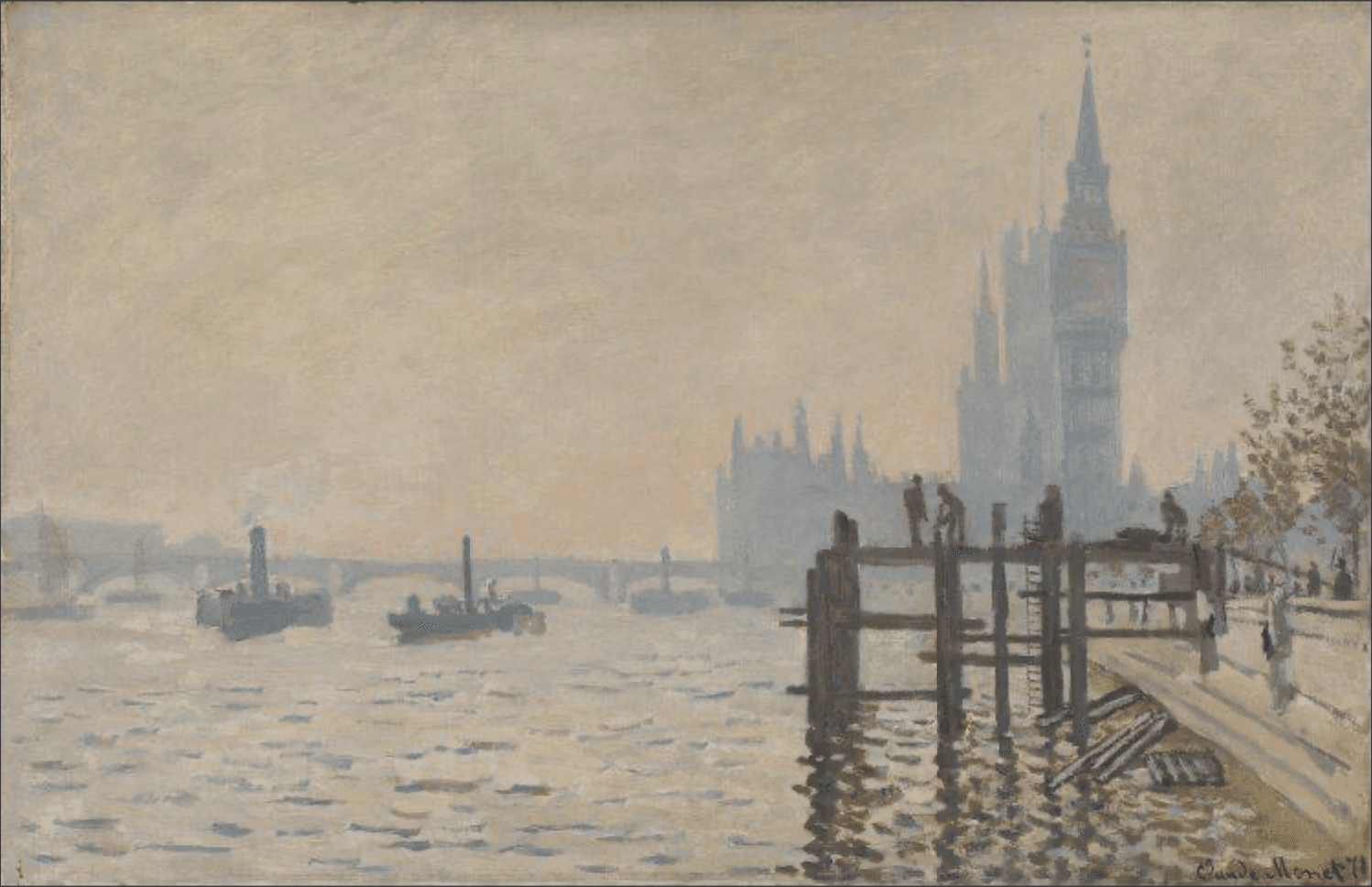
Look closely at this painting, and it is the fog that catches the eye before the buildings do.
Light spreads across the water,
and the bridge and sky merge in a boundary that blurs and dissolves.
Monet had no interest in rendering the city before him with precision.
What he wanted to capture was how light trembled through the air at that particular moment.
His London landscapes, then, feel less like simple cityscapes
and more like records of a fleeting instant conjured by light and fog together.
Perhaps Monet was not looking at the buildings of London at all,
but gazing instead at the color of time, slowly shifting in the fog.