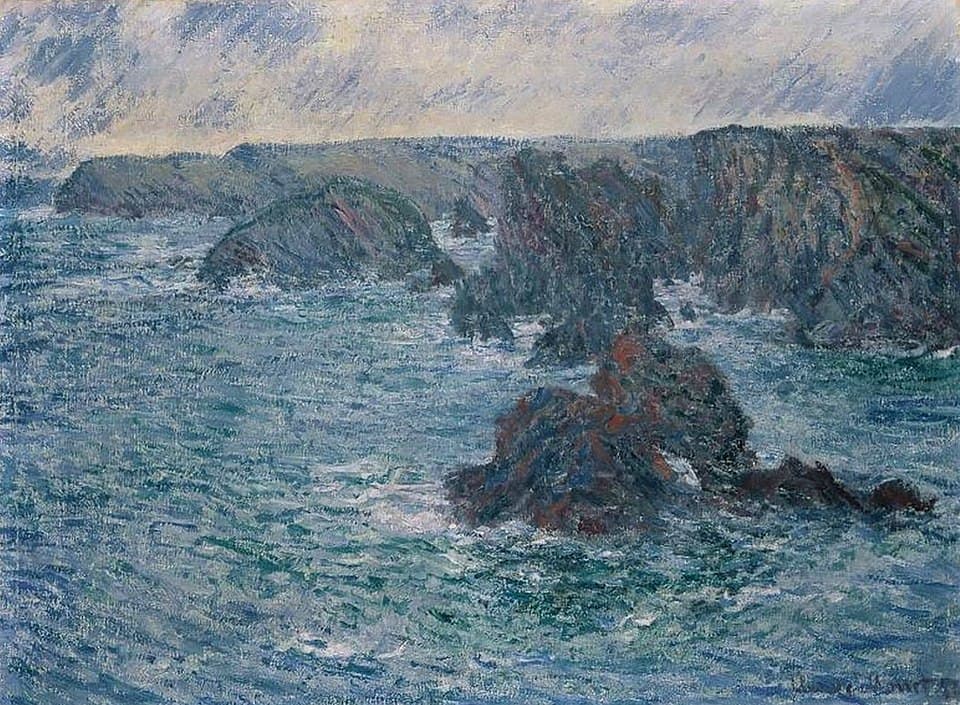
Belle-Île
The waves keep breaking.
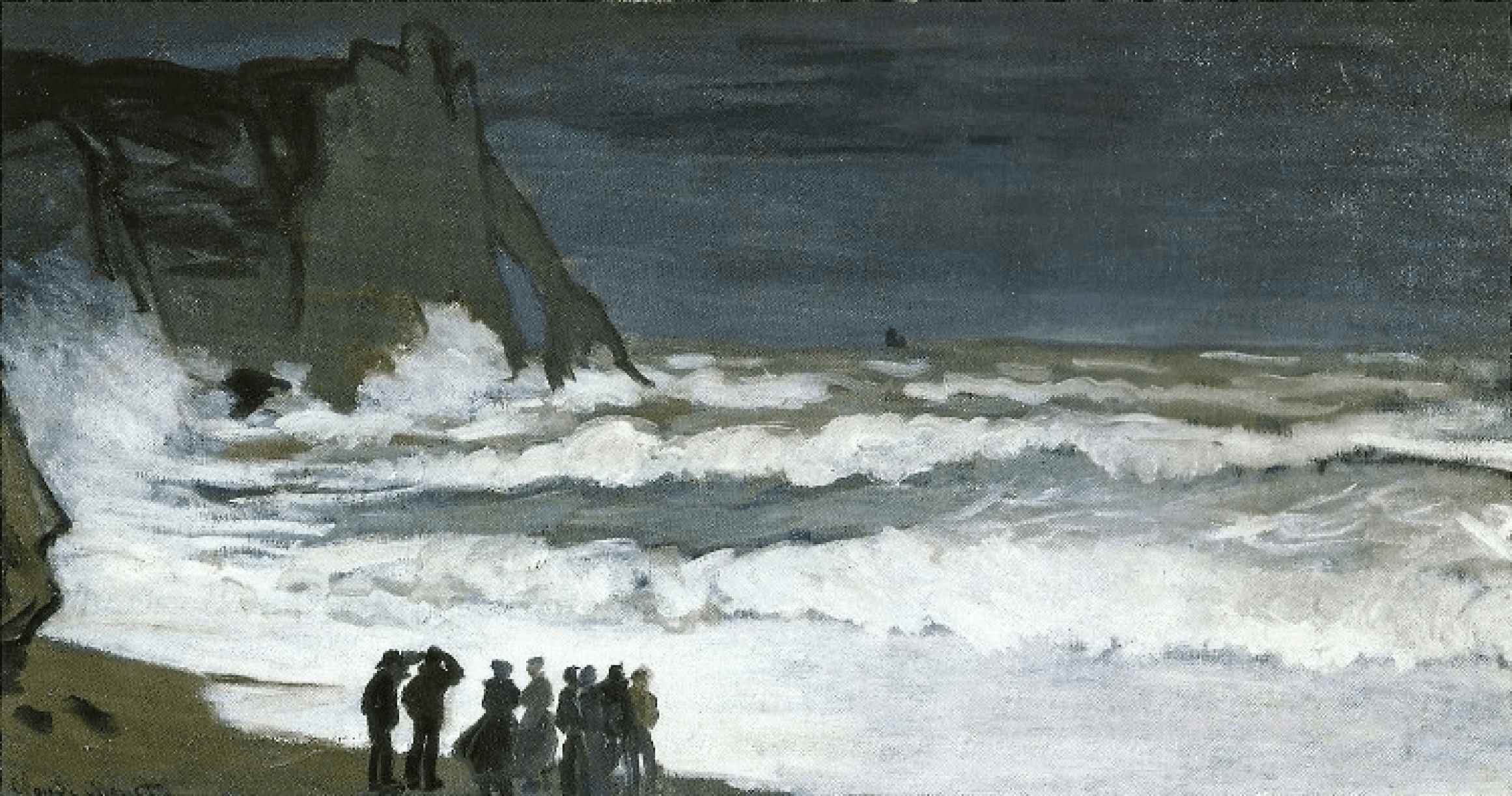
And Monet stood at the edge of a wind-lashed cliff, trying to seize that very moment.
Claude Monet stayed on Belle-Île, a remote island off the Breton coast, and painted the sea with something close to obsession.
Light that shifted dozens of times in a single day.
The color of the water changing with every passing cloud.
And waves that moved as if they might swallow everything whole.
He carried his canvases along the rugged coastline himself.
Facing the wind. Dodging the waves.
The brushwork in this painting did not come from the safety of a studio.
It feels like the trace left by a body doing battle with nature.
Two Masters Who Recognized Each Other's Genius
Exactly when Auguste Rodin and Monet grew close is not clearly documented.
But there is one figure often cited as the person who brought them together: the art critic Octave Mirbeau.
Mirbeau is said to have looked at the two men and felt certain:
"These two are on the same adventure."
One carved emotion from stone,
while the other captured fleeting moments in light.
And one day, the two masters exchanged works.
Monet gave Rodin one of the Belle-Île paintings from this very series,
and Rodin gave him in return the sculpture She Who Was the Helmet-Maker's Once-Beautiful Wife.
A rather audacious exchange.
But in the end, a perfect win for both.
Each became, in his own right, the defining master of his era.
Painting Not the Sea, but a "Moment"
Now look at this painting closely.
The waves are not simply painted white.
Blues, grays, and soft violets keep blending and trembling together.
Even the rocks are not fixed firmly in place.
They appear to melt according to the light.
This is the revolution of Impressionism.
Where painters before sought to depict "the thing itself,"
Monet painted "the sensation that flashed into the eye at a given instant."
So he was not, in the end, painting the sea —
he was painting the tremor of a single glance cast upon it.
That is why this painting still feels, strangely, alive.
You can almost hear the waves, almost feel the cold wind on your skin.
Perhaps Monet was not leaving behind a landscape at all —
perhaps he simply wanted to hold on to a moment just before it disappeared.