David
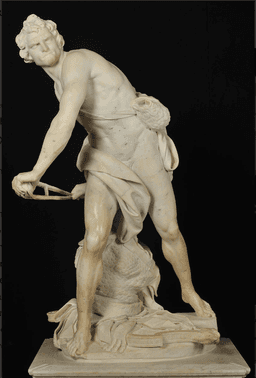
This is Gian Lorenzo Bernini's David.
Begin by looking at David's face.
His lips are pressed tight, every muscle in his body coiled with effort. This is not the moment after the stone has been released — it is the instant just before.
A sling is gripped in his hand, and his torso is wrenched into a deep twist. He is gathering the full force of his body to hurl the stone as far and as hard as possible.
This is, unmistakably, cold stone — and yet it seems on the verge of motion.
What Sets This David Apart from Michelangelo's
Bernini's David is frequently compared to Michelangelo's David.
Where Michelangelo's David stands in quiet contemplation before the fight, his gaze fixed steadily on Goliath, Bernini's David is already in the thick of battle.
What registers first here is not the beauty of the body, but movement and tension.
This is precisely the power of Baroque sculpture.
The Objects at His Feet
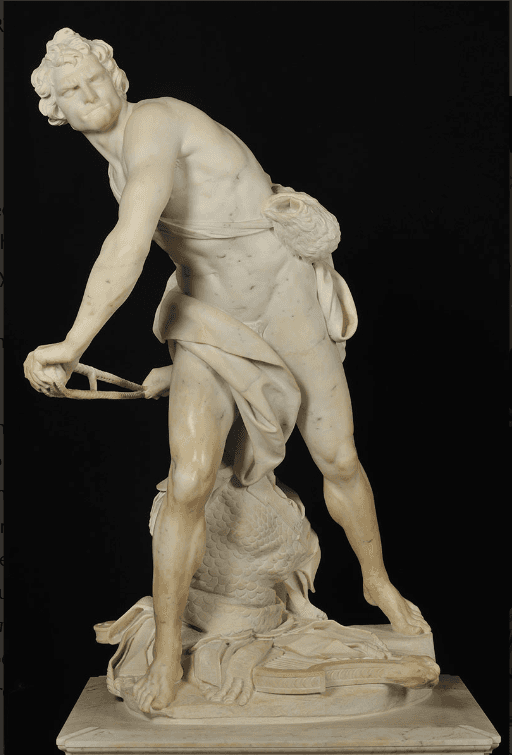
Now look at what lies beneath David's legs.
There is a suit of armor and a musical instrument.
The armor was borrowed from King Saul, but David set it aside because it hindered his movement. Rather than bear the weight of heavy armor, he chose to face Goliath with nothing but a sling.
The instrument beside him is a kithara — an object that evokes the song of thanksgiving David would offer to God after his victory.
Look closely: the instrument is adorned with an eagle.
The eagle is the emblem of the Borghese family, who commissioned this work. Bernini wove a trace of his patron seamlessly into the sculpture itself.
The Hopes of the Borghese Family
This work held a particular significance for the Borghese family.
Once a family of formidable power, the Borghese had seen their influence wane with the changing of the papacy. But with the rise of the new pope, Urban VIII, they began to harbor hopes of reclaiming their former standing.
It was at this moment that the Borghese family commissioned Bernini to create this David.
The young David, on the verge of defeating the mighty Goliath.
Perhaps this scene mirrored something of the Borghese family's own longing to rise again.
Bernini's Own Face
Look once more at David's face.
Intriguingly, it is widely held that the face is modeled on Bernini's own features.
By placing his own likeness within David's expression, the sculptor rendered the tension and concentration of the moment before combat all the more vivid.
Pause for a moment before the sculpture.
David has not yet released the stone.
Yet because this is the very instant before he does, the mind reaches forward — to the stone in flight, to Goliath falling.