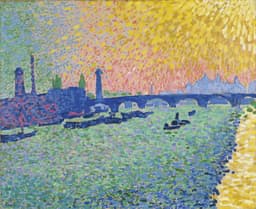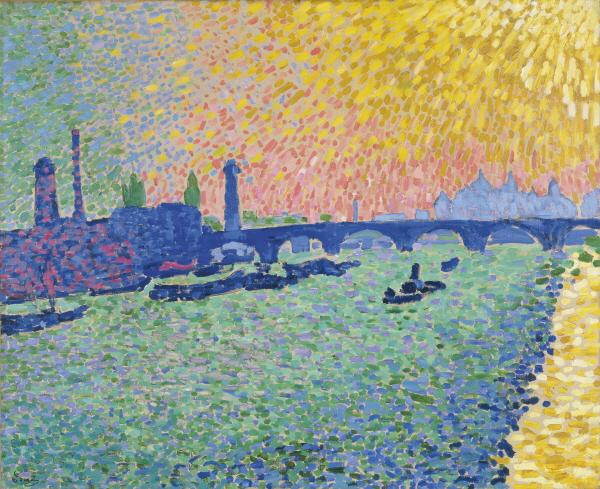
Waterloo Bridge
From a distance, the sea and sky seem to shimmer and sparkle.
Step closer, and the colors resolve into scattered points, small as dots.
André Derain is one of the defining figures of French Fauvism, a painter with a particular fascination for capturing the beauty of light through pointillist technique — an approach shaped in no small part by the influence of Georges Seurat and Paul Signac.
Why Not Mix the Paint?
Traditionally, painters mix pigments together to arrive at the color they want. The drawback is that mixing muddies the hues, dulling their saturation.
The Pointillists refused to mix. Instead, they placed pure, unmixed dots of primary color side by side on the canvas.
Place a red dot next to a yellow dot, for instance, and viewed from a distance the eye blends them naturally into something resembling orange. It is the same principle by which a black-and-white checkerboard reads as gray when seen from afar.
The Man Who Changed Derain's World
There was one other figure who proved decisive for Derain: Henri Matisse.
Matisse was a painter who expressed emotion through fierce, gestural brushwork and bold primary colors. Where Cubism sought to analyze form, Fauvism placed its faith in the sensation and energy that color alone could deliver.
More Intense Than What the Eye Sees
The Impressionists had set out to observe the way light transforms objects as it touches them. The Fauves took that ambition a step further.
They wanted color itself to become light.
By pushing their palettes far beyond the hues of any actual landscape, they sought to convey not what a scene looked like, but what it felt like — its emotion, its atmosphere, its charge.
And yet even this revolutionary current could not sustain itself for long.
Fauvism blazed intensely from 1905 to 1907, then vanished almost as quickly as it had arrived.
But that brief, incandescent moment was enough to change painting forever: color would no longer simply follow reality. It had become a language for detonating emotion.