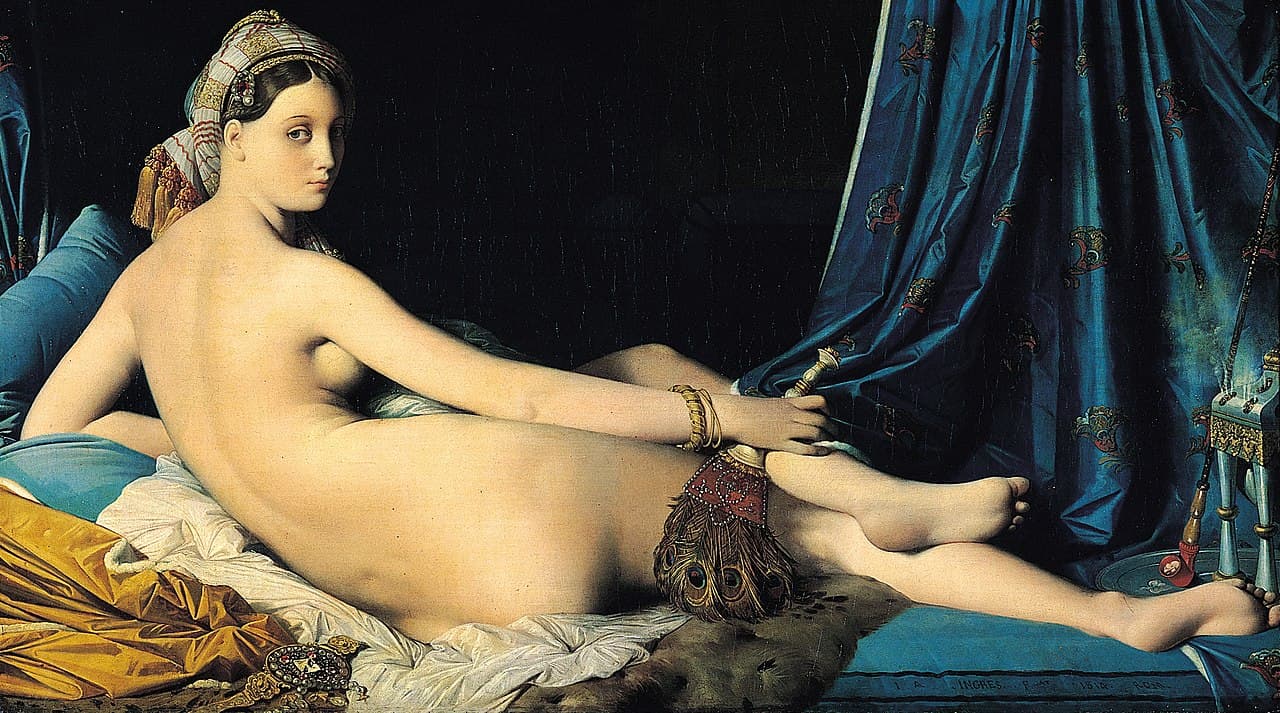
Grande Odalisque
An Age That Imagined Unfamiliar Worlds
A woman lies with her back turned to us.
Pale skin flows in a long line across blue fabric, while a turban, a fan, and the deep texture of the cloth slowly envelop the canvas.
And yet, something is strange.
It is clearly a scene of repose, but the body feels somehow unreal.
The waist is excessively long, and the direction of the legs is subtly twisted.
That is why this painting sparked an enormous controversy when it was first unveiled.
It is Ingres’s Grande Odalisque.
In nineteenth-century France, when this work was painted, “Orientalism” was in vogue.
Today, the word Orientalism may bring East Asia to mind, but the East that Europe imagined at the time was far broader.
Turkey, the Middle East, Egypt, even North Africa.
To Europeans, those lands felt foreign, mysterious, and somehow dangerous.
And the painting’s title, “odalisque,” originally referred to a woman who attended the Ottoman sultan, the Islamic sovereign.
The Harem Fantasy Europe Invented
People at the time held a particularly intense fascination with the space known as the “harem.”
The harem was originally the living quarters of women, closed to outside men, but in Europe it was consumed in an entirely different way.
It was distorted into something like a secret chamber where the sultan indulged in pleasure with his women.
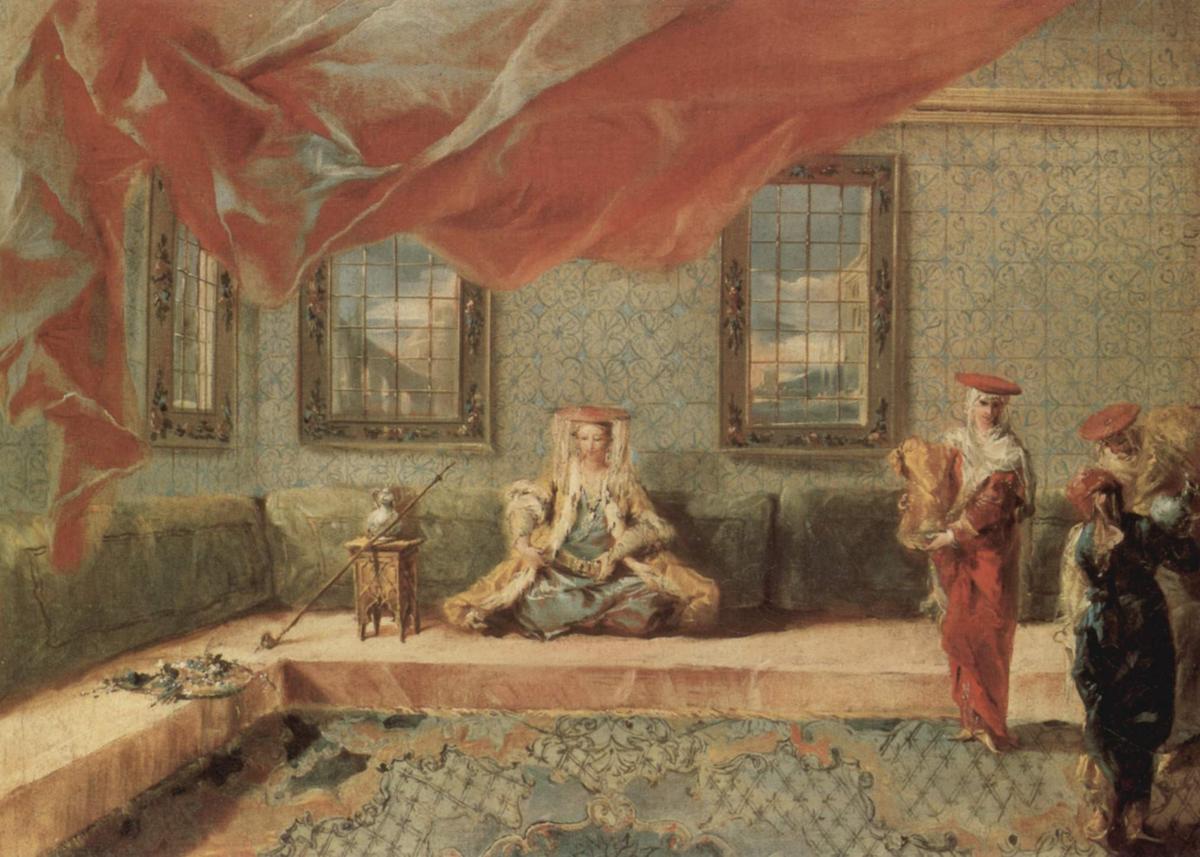
As a result, the woman in this painting was received not as a mere figure, but as an object that stirred the clandestine fantasies of French men of the day.
Seen today, it may feel like an elegant painting, but at the time it was remarkably provocative.
What is more shocking still is that this woman was not a goddess from mythology but was painted from a real person.
In Western art, the nude was not readily permitted.
So it was usually dressed up as the body of a mythological being, such as Venus or a nymph.
Ingres, however, took a real person as his model.
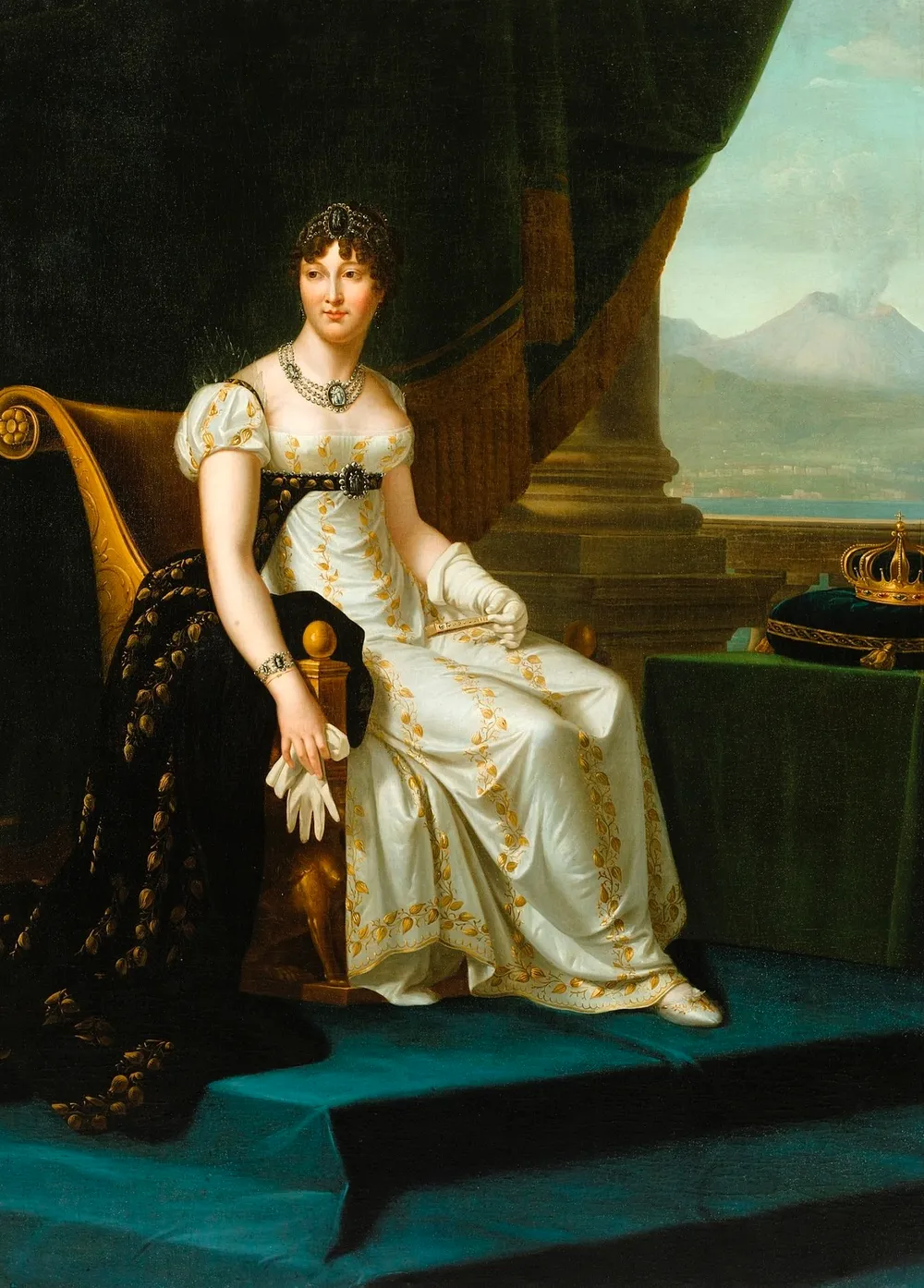
And that person, astonishingly, was Napoleon’s younger sister, Caroline.
A Painting Left Behind by Napoleon’s Fall
In fact, this work was originally commissioned by Caroline for her private collection.
At the time, Ingres was close to the Napoleonic family and was a painter respected in royal and aristocratic circles.
But before the painting could even be completed, the tide of history turned completely.
Napoleon fell.
The family had to flee in haste, and could not take this enormous painting with them.
And so Ingres was left with the painting, never having received payment for it.
He ultimately submitted the work to the Paris Salon of 1819.
But what came back was not praise but ridicule.
A Waist Grown Too Long
Now look closely at the woman’s body once more.
The waist is strangely long, isn’t it?
In fact, people at the time mocked it, saying, “She seems to have two extra vertebrae.”
The legs are awkward too. The left calf rests atop the right thigh, and if you actually try to imitate that pose, it is quite uncomfortable.
So people said:
“A royal painter, and he can’t even draw the human body properly?”
But did Ingres really paint it that way out of ignorance?
Of course not.
Ingres was among the finest draftsmen in France at the time. He understood the structure of the human body more precisely than almost anyone.
He bent reality on purpose.
For what mattered to him was not the “accurate body” but the “beautiful line.”
Ingres did not see the human body through anatomy. He saw it as the flow of a great curve.
So the waist grew longer, the back more supple, and the whole body continues as softly as a serpent.
The body of reality collapsed, but in its place, perfect elegance was born.
Beauty Sometimes Refuses Reality
Today, this work is regarded as a masterpiece representing Neoclassicism.
But to the people of its time, it was far too unfamiliar.
For Ingres was not simply painting a person; he was painting an illusion more beautiful than reality.
Perhaps this painting is less the body of a real woman than the very embodiment of the desire and fantasy that nineteenth-century Europe held about the East.