Apples and Oranges
Have you ever heard of the “Four Great Apples of the World”? The list includes the apple of Adam and Eve, Newton’s apple, and the two we are about to turn to: Cézanne’s apple and Steve Jobs’s apple. The apple of Adam and Eve is tied to the creation of humankind, and Newton’s apple is said to mark the beginning of modern science. Why does Cézanne’s apple deserve a place beside them? Let’s look at the painting and find out.
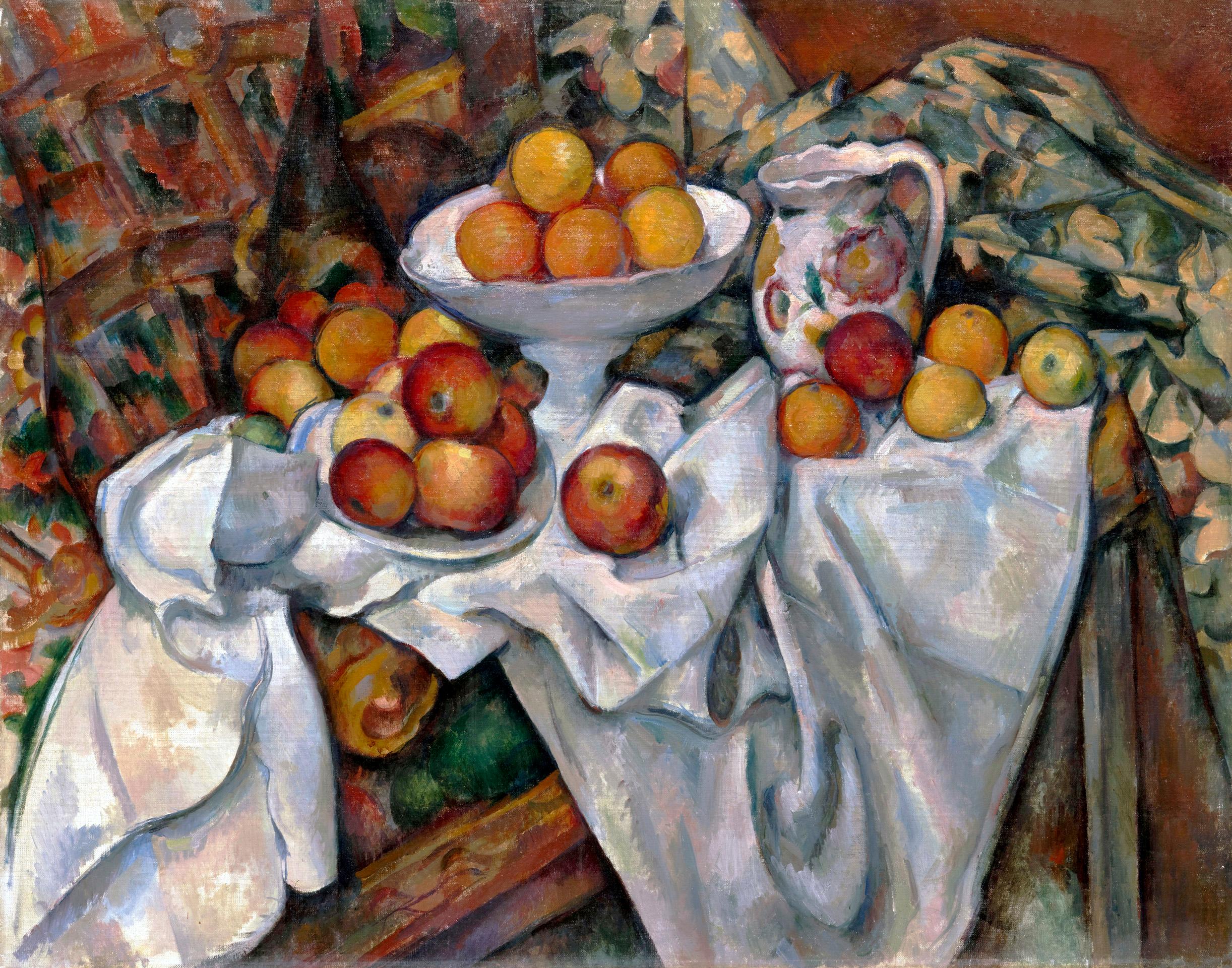
Apples and oranges sit on a table. A painting of fruit, flowers, bowls, and the like is called a still life. Judging from the image alone, though, it is hard to see what makes this such a remarkable work.
Yet this painting holds many of Cézanne’s experiments. First, please look at the image on the screen.
I have marked an orange. Can you see it? This orange was painted from the front, at the same eye level as ours. But now look at the spot I have marked as an apple. This apple was not painted from the front; it was painted looking down from above. That is why we can see the top of the apple. Does that make sense?
So in this painting, an orange painted from a frontal viewpoint and two apples painted from a viewpoint above coexist within a single canvas.
Paintings in general were composed from one single viewpoint. Cézanne believed that a single painting could contain multiple viewpoints, and so he painted this way.
Because this painting completely shattered the fixed idea that a picture must be painted from only one point of view, Cézanne’s apple is called the origin of modern art. It is said that when he left for Paris to study art, Cézanne declared, “I will conquer the world with a single apple.” In the end, he made that dream come true.
Cézanne also painted apples and oranges especially often in his still lifes. There were probably several reasons, but chiefly, compared with other fruits, they take longer to soften even when left out, so they could hold their form for a longer time.
Now, please take your time with Cézanne’s apples and oranges, the works said to mark the beginning of modern art.