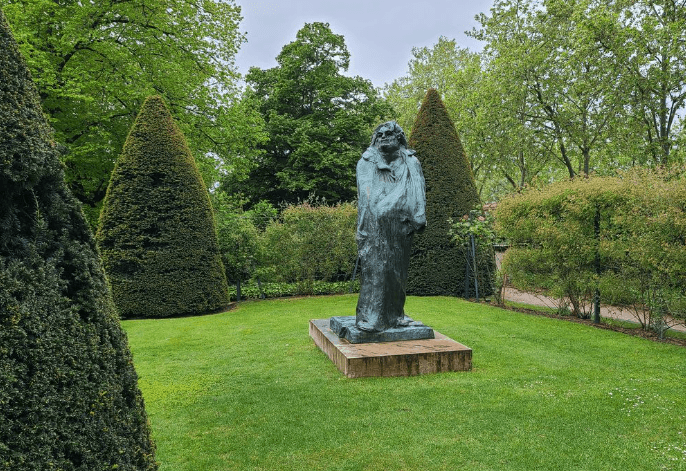
Monument to Balzac
Balzac was a master of nineteenth-century French realist literature. To mark the fiftieth anniversary of his death, the Société des Gens de Lettres conceived a plan to create a commemorative sculpture in his honor. On the recommendation of Émile Zola, who had been elected president of the society at the time, Rodin was commissioned to make the statue. Rodin held Balzac in the highest esteem as a titan of literature, and he threw himself into the work with everything he had. Before even beginning to sculpt, he spent four years researching Balzac alone, followed by three years of actual work — seven years in total devoted to this single piece.
Take a moment to look at the work. Does it strike you as masterfully done, or does something feel off? When I pose that question, the responses tend to split almost evenly down the middle.
At the time of its unveiling, however, the sculpture was met with withering criticism. Some said it looked like a snowman; others looked at Balzac's face and likened it to a toad. The Société des Gens de Lettres, which had commissioned the work, refused to pay and canceled the contract outright. For my part, I find it difficult to see what was quite so objectionable.
I have included an image of Balzac as he appeared in life — have a look. Doesn't the sculpture bear a rather close resemblance? He did carry a bit of a belly, and the face is similarly convincing. Rodin had researched everything about Balzac before making this work: his face, his physique, his daily habits. How could the result have been anything but faithful to life? And yet what the Société most likely wanted was something grander — a more dignified, more august image of the great writer. In any case, the society ultimately refused to accept the sculpture, and Rodin kept the plaster cast until his death. Twenty years after he died, it was finally cast in bronze.
Today, one bronze cast stands in the Musée Rodin in Paris, and another is on display near the Vavin métro station, also in Paris.